

Good freelance goals are specific, dated and pointed in a direction you chose yourself.
Set a handful of short term goals for the next few months, a handful of long term goals for the next two years, and a date to review them. That’s all the structure you need.
The harder part is deciding what progress means for you. Forward doesn’t have to mean bigger. It means towards the business you actually want.
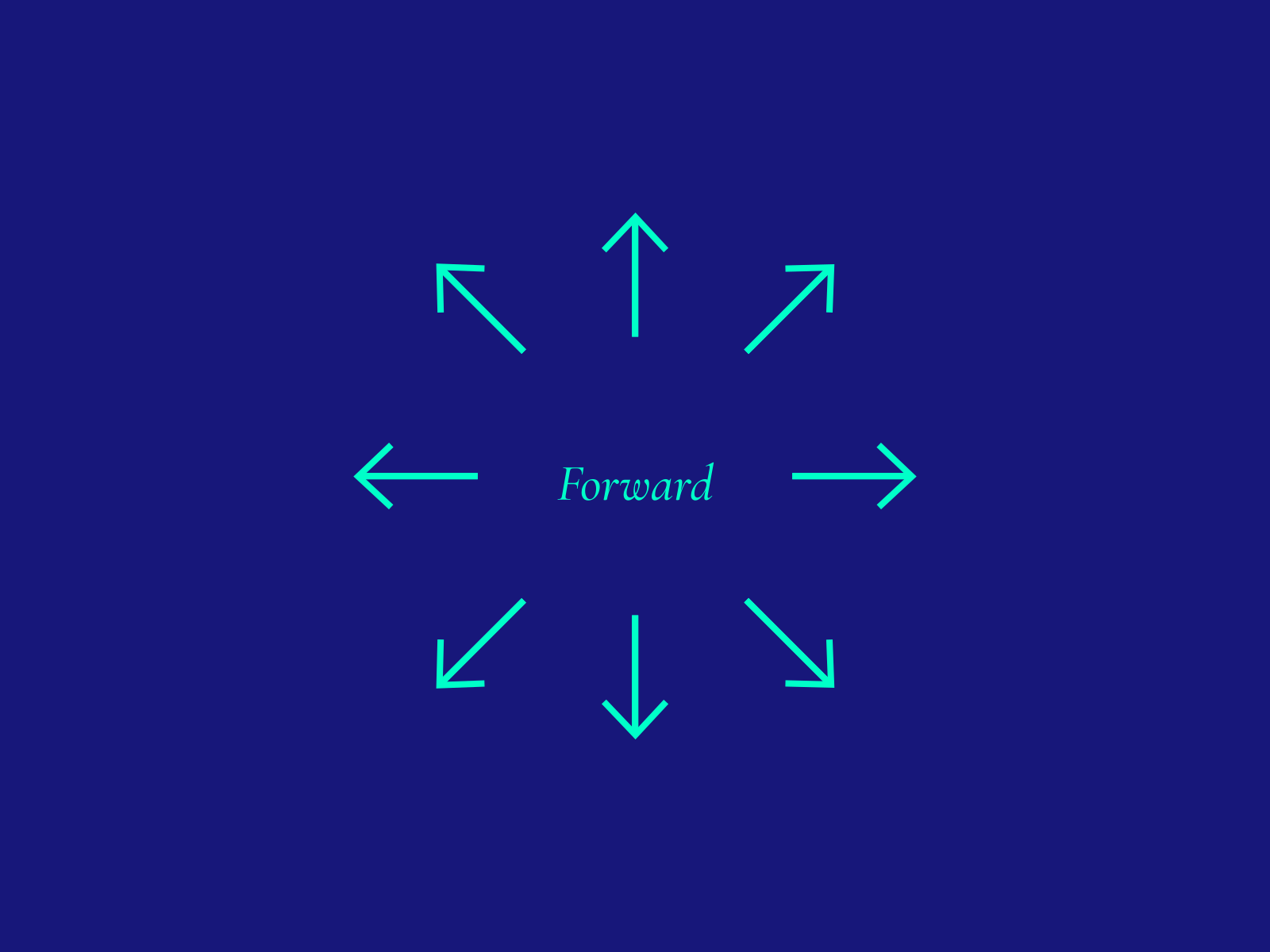
The illustration in the book is eight turquoise arrows pointing outwards from the word Forward: up, down, sideways and every diagonal. The lesson puts it this way: in a multidimensional universe, forward motion can go in any direction. You decide what forward means, and you can change course whenever it stops making sense.
Why the default kind of progress can mislead you
Most of us inherit a definition of progress without thinking about it: more clients, more hours, more money. Followed blindly, it can lead to a business that looks successful and feels exhausting.
For some freelancers, forward means fewer clients at a higher price. For others it means a shorter week, a new skill, a different kind of work or more time abroad. None of those is more correct than the others. What matters is that your goals serve the direction you picked, not one you absorbed from someone else.
Short term and long term goals from the book
Short term goals cover roughly the next six months to a year and should be things you can start on this week. Long term goals look one to two years ahead and describe the shape of the business. In the book, the example lists read like this.
Short term:
- Build a professional website within the next 3 months
- Get 5 new clients within the next 6 months
- Raise my prices by 10% within the next year
- Attend a professional development workshop or conference within the next year
Long term:
- Establish a consistent client base within the next 2 years
- Increase my annual income by 50% within the next 2 years
- Develop a specialised niche or area of expertise within the next 2 years
- Transition into a full time freelancer within the next 2 years
- Expand services to include consulting within the next 2 years
One small change from the original: the book says “increase my hourly rate”. Here it reads “raise my prices”, because later lessons recommend moving away from hourly pricing altogether.
Goals for different kinds of forward
The book’s examples lean towards growth, which suits a lot of people. If your direction is different, your goals should look different too. Here are a few illustrative pairs.
| If forward means | A short term goal | A long term goal |
|---|---|---|
| More freedom | Keep Fridays free for 8 weeks | Work four days a week on the same income |
| Better clients | Pitch 3 clients from my target list | Half my income from clients I’d choose again |
| Higher value | Add a premium package to my offer | Double my average project value |
| Less admin | Create templates for proposals and invoices | Admin under 3 hours a week |
| New direction | Finish one personal project in the new style | First paid project in the new area |
Imagine a wedding photographer who is tired of working every weekend from May to September. Their forward might be fewer, better paid weddings plus a second line of portrait work in the week. A copywriter who wants to travel might care far more about clients who are happy to work remotely than about income growth.
How to write goals that hold up
Start by finishing one sentence: for me, forward means… If you made a scoreboard in how to stop comparing yourself to other freelancers, use it here.
Then make each goal specific and dated. “Get more clients” is a wish. “Get 5 new clients within 6 months” is a goal. If you know George T. Doran’s SMART method (specific, measurable, achievable, relevant, time bound), it fits well, but a number and a date already do most of the work.
Keep the list short. Three to five short term goals and three to five long term goals is plenty. Any more and none of them get proper attention.
Finally, set review dates. Redirecting is part of the lesson, so put a review in your calendar every three months. Ask whether this is still the direction you want, what’s working and what you should drop.
Where goal setting goes wrong
The most common problem is only setting income goals. Money matters, but goals about your time, your clients and the type of work protect the life you’re building.
Another is choosing goals you don’t control. Winning an award depends on a jury. Entering two awards depends on you.
Then there’s the list that never gets looked at again. A goal set in January and forgotten by March is just a nice note.
And be careful of borrowing someone else’s forward. A peer’s plan to grow into a studio with staff may be the opposite of what you want.
Try it in 15 minutes
- Finish the sentence: for me, forward means…
- Write three short term goals, each with a number and a date.
- Write three long term goals for the next two years.
- Book a review in your calendar three months from today.
One page, three months, then look again.
All Laid Back Freelancing lessons
Cover photo by Diego Jimenez on Unsplash.