

It’s hard to plunge into the unknown, especially when you give up a stable job. So don’t plunge.
The safest way to transition to freelancing is to stop thinking of it as a leap. Build the foundations while you still have a salary: a few paying clients, some reviews, a portfolio that shows the work you want, a decent online presence and enough savings to cover the quiet months. When you finally hand in your notice, you’re stepping down onto something solid.
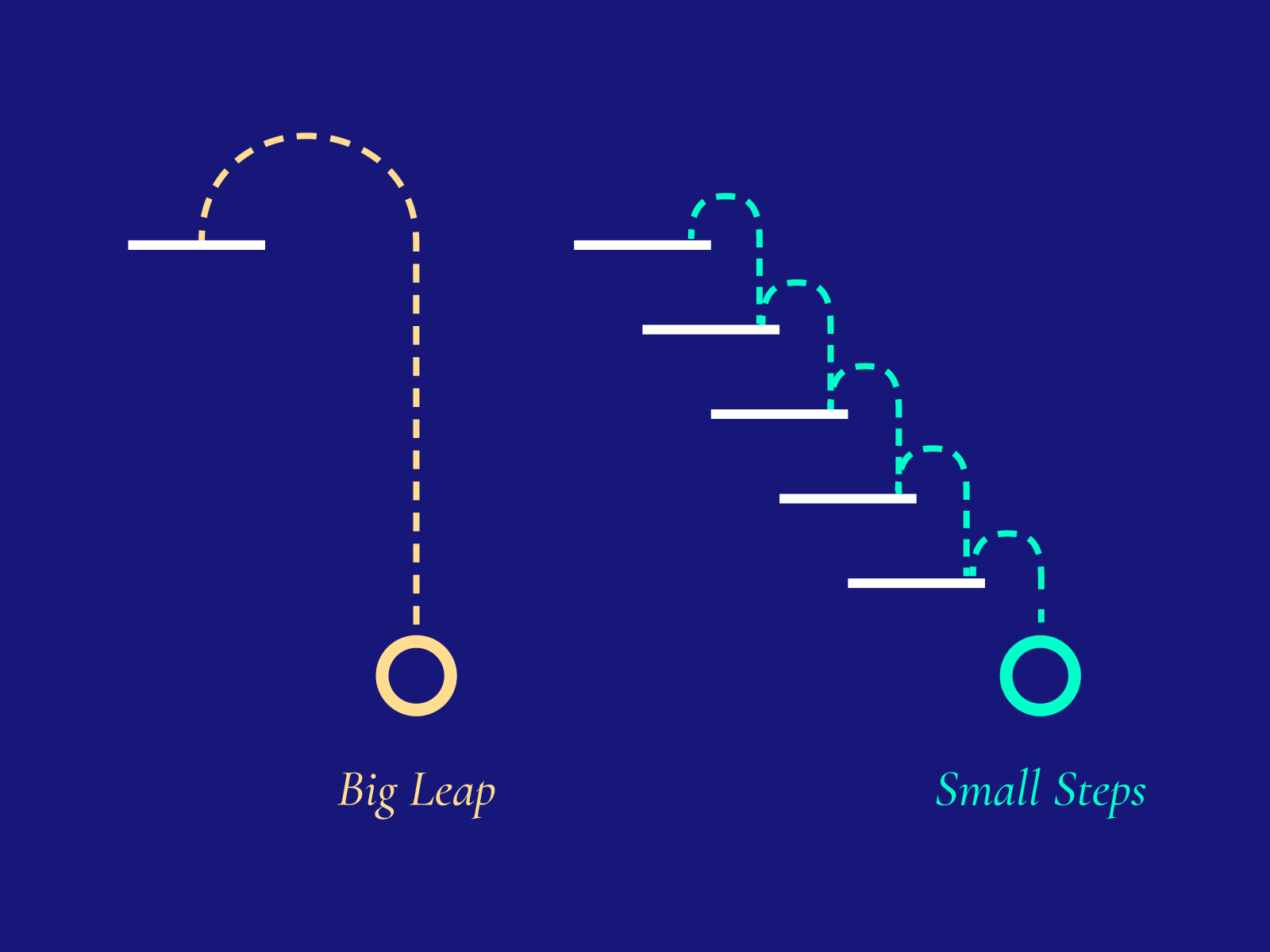
The illustration in the book shows two ways down from the same height. On the left, a single ledge and a long yellow dashed line dropping straight to a circle labelled Big Leap. On the right, the same drop broken into a staircase of short turquoise hops, ending at a circle labelled Small Steps. Both routes reach the bottom. Only one of them is a fall.
Why the big leap hurts
Quitting in one go feels decisive. It’s also the version that puts the most pressure on your first months. You need clients immediately, so you take whatever comes at whatever price, and you start your business by undercharging. That habit is hard to undo.
I know the pull of the big gesture. I worked as a digital designer at a London agency and felt like a caged animal there. Later I landed in a remote part of Indonesia with £500 and a battered laptop. That’s the big leap version, and I wouldn’t hand it to anyone as a plan. The staircase below is calmer.
Five steps to take before you quit
Decide what kind of freelancer you’re becoming
Before you look for clients, write down the clients you want, the projects you want and the hours you want to work. You don’t need a perfect niche yet, and how to test freelance niches covers that later. You do need a direction, so your first clients point the right way.
Land one or two clients while you’re employed
Start small and keep it clean. Check your employment contract for conflicts and keep side work outside office hours. One reliable client who pays on time tells you more than any business plan, and a long running client, even a small one, makes the move far less frightening.
Collect proof as you go
Each project should leave you with something you can reuse: a case study, a testimonial, a before and after. By the time you quit, your website and portfolio should show the work you want to be hired for, not just work your employer owns.
Build your runway
In the book, the example answer to “How much money do I need to save to start freelancing?” is six months of expenses. That’s a sensible target for most people. Work it out from what you actually spend each month, not from your salary.
Say your costs look something like this:
| Monthly cost | Amount |
|---|---|
| Rent and bills | £1,100 |
| Food and transport | £450 |
| Insurance, software, phone | £150 |
| Monthly total | £1,700 |
| Six month runway | £10,200 |
If six months feels out of reach, stay employed a little longer, cut costs, or move to part time hours for a while. Each extra month of runway buys you the right to say no to a bad client.
Set your exit trigger
Pick a clear signal that means now. For example, two clients who have each paid you at least twice, plus the full runway sitting in a separate account. Without a trigger it’s easy to wait forever, or to quit on a bad Monday.
The questions to answer first
The original lesson lists ten planning questions, covering clients, schedule, rates, skills, free time, long term vision, marketing, how you’ll measure success, how you’ll handle setbacks and how much to save. Three of them matter most at this stage. The rest come up again in later lessons.
The first is what kind of clients and projects you want to work with. In the book, the example answer is tech startups.
The second is your ideal work schedule. The example is 8am to 12pm, about 20 hours a week, set hours, no work at weekends, 60 days of holiday and 10 days of sick leave. It’s a good reminder that you get to design the week, not just fill it.
The third is how much you need to save, which the example puts at six months of expenses.
The book’s example also gives an hourly rate. Later lessons argue against charging by the hour, so treat any hourly figure as a private benchmark for checking your project prices, never as the price you quote.
Mistakes that make the move harder
The biggest one is quitting before a stranger has paid you. Friends and former employers are a fine start, but they aren’t proof that the market wants what you sell.
Tax catches a lot of people out. Set aside a share of every payment from day one, and check the current rules for your country.
Some people save towards their old salary instead of their real costs. Your runway only has to cover what you spend.
And watch what goes into your portfolio. Every project you show invites more of the same, so don’t fill it with work you’d rather not do again.
Questions people ask
Should I quit my job to freelance?
Only once you have proof that strangers will pay you, a runway of savings and a clear exit trigger. Until then, keep the job and build those on the side.
Can I freelance while working full time?
Usually, yes. Check your contract for clauses about outside work, competitors and intellectual property, keep client work outside your working hours, and never use your employer’s equipment or clients.
How much should I save before going freelance?
The book’s example is six months of expenses. Base it on what you spend each month, including insurance and money set aside for tax, not on your salary.
Try it in 15 minutes
- Write your answers to the three questions above: clients, schedule and savings.
- Add up your monthly costs and multiply by six. Write that number down.
- List the five steps and note where you are on each.
- Write one next action for the step you’re on now.
Keep the list. It’s your transition plan, and every tick takes you one step down instead of one big drop.
All Laid Back Freelancing lessons
Cover photo by Lisa Baker on Unsplash.