

If you try to talk to everyone, you have very little leverage. Your words get spread so thin that nobody feels they were meant for them.
The fix starts with two terms that often get mixed up. Your target market is the large group of people who would benefit from your service. Your target audience is the smaller group inside it that you choose to speak to with your marketing. Narrow the message to one audience and it lands with far more force.
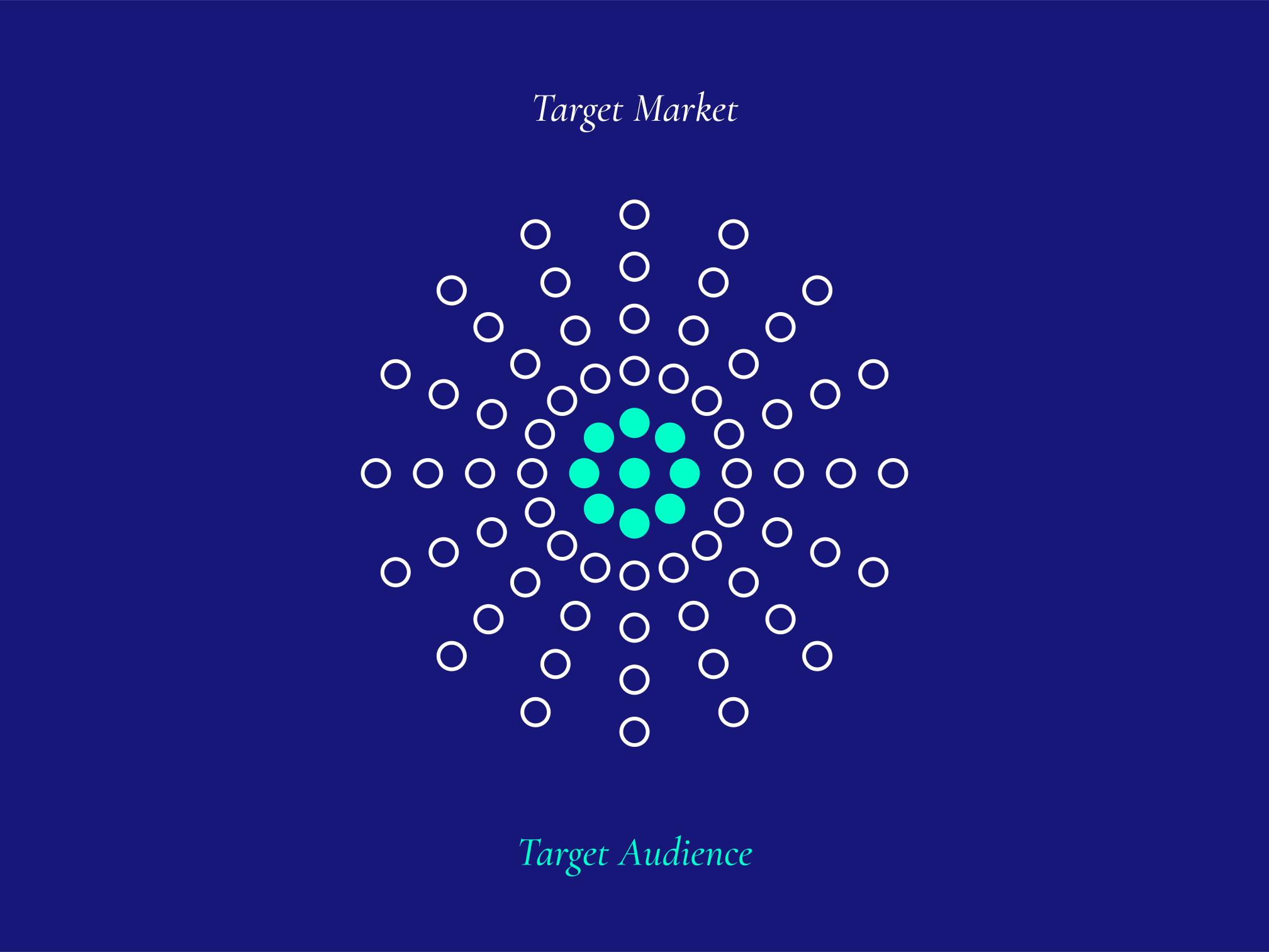
The illustration in the book shows a wide ring of small white circles labelled Target Market, and at its centre a tight cluster of solid turquoise dots labelled Target Audience. Everyone in the ring could hire you. The filled dots are the people your website, portfolio and posts are actually written for.
What’s the difference between a target market and a target audience?
The market answers the question “what business am I in?” The audience answers “who am I talking to?”
Say you’re a brand designer. Your market is small businesses that need a visual identity, which is a huge and varied group. Your audience might be independent coffee roasters in the UK opening their first café. A copywriter’s market could be companies that sell online, while their audience is software startups that have just raised their first round of funding.
The market keeps your options open. The audience makes your message sharp. You still accept good clients from the wider market. You just don’t write for them.
Why narrowing feels risky but isn’t
It feels as if talking to fewer people must mean fewer clients. In practice, a message aimed at everyone gets ignored by everyone.
Picture that coffee roaster reading a portfolio full of café brands, with copy that describes the exact problems of opening a first shop. They don’t compare you with a hundred other designers. You’re the obvious fit, and price becomes a smaller part of the conversation.
The wider market hasn’t gone anywhere. A bakery that finds you through a friend can still hire you. You’ve simply stopped trying to please every reader at once.
Build an ideal client profile
The book’s advice is to pick or imagine your most valuable client and create a persona with the information you have. That blueprint helps you define who your ideal clients are.
In the book, the example persona is 35, works in real estate and lives in London. They love travelling, fishing and action movies. Their motivations are to create an impact, help their clients, have more free time and build a family. You’d find them on Instagram, Facebook and in property magazines. Their frustrations are no free time, expensive employees and no system for their work.
Notice how much more useful the motivations and frustrations are than the age. They tell you what to say, not just who’s listening.
To build your own, answer these about one real person:
- What’s their role and business, and how big or established is it?
- Where are they based, and what are they like outside work?
- What do they want most from their business right now?
- What’s in the way, and what have they already tried?
- Where do they spend time online and offline, and who influences their decisions?
- What words do they use when they describe the problem?
The last question matters most. If you’ve had real conversations using customer discovery questions for freelancers, copy their exact phrases. They’ll do more work on your website than anything you could write yourself.
Start from a real client, not a fantasy
A persona built only on imagination can describe someone who doesn’t exist. Start from your best real client, the one who paid well, valued your work and was good to work with. Fill in what you know about them, then check the gaps by talking to a few people like them.
If you offer very different services, you may need two profiles. Keep it to two, or you’re back to talking to everyone.
Put the profile to work
A profile in a drawer changes nothing. Use it every time you write or decide something about your business.
Your website headline should speak to their main frustration in their own words. Your portfolio should show their kind of project first. Your outreach should happen where the profile says they spend time. And your offer should fit what they can afford, which is where packaging your freelance services into levels helps.
Mistakes to avoid
The most common one is confusing demographics with insight. Age and location tell you far less than motivations and pains.
The second is making your audience a whole industry. Hospitality is a market. Boutique hotels with fewer than 30 rooms is an audience.
The third is refusing good clients who sit outside your audience. Narrow the message, not the door.
And finally, don’t write the profile once and forget it. When your best clients change, update it.
Questions people ask
What is the difference between a target market and a target audience?
Your target market is everyone who could benefit from your service. Your target audience is the smaller group within it that your marketing speaks to directly.
Is an ideal client avatar the same as a target audience?
Not quite. The audience is a group. An ideal client avatar, or persona, is a detailed portrait of one typical person in that group, used to make your message specific.
Will narrowing my audience lose me clients?
No. You narrow the message, not who you accept. Good clients from the wider market can still hire you.
Try it in 15 minutes
- Think of your single most valuable client, past or present.
- Answer the six profile questions above using what you know about them.
- Circle the frustration that comes up most strongly.
- Write one sentence for your website that speaks directly to it, in their words.
You now have a profile you can test every headline, post and proposal against.
All Laid Back Freelancing lessons
Cover photo by CHUTTERSNAP on Unsplash.