

Clients don’t need a website. As the book puts it, they need a cheap and effective way to show their brand anywhere, at any time, on any device in the world.
That’s the difference between a deliverable and a pain point. The deliverable is what you make. The pain point is the problem the client lives with. Find the problems your audience has, show how your service solves them, and selling gets much easier, because you’re finally talking about what they care about.
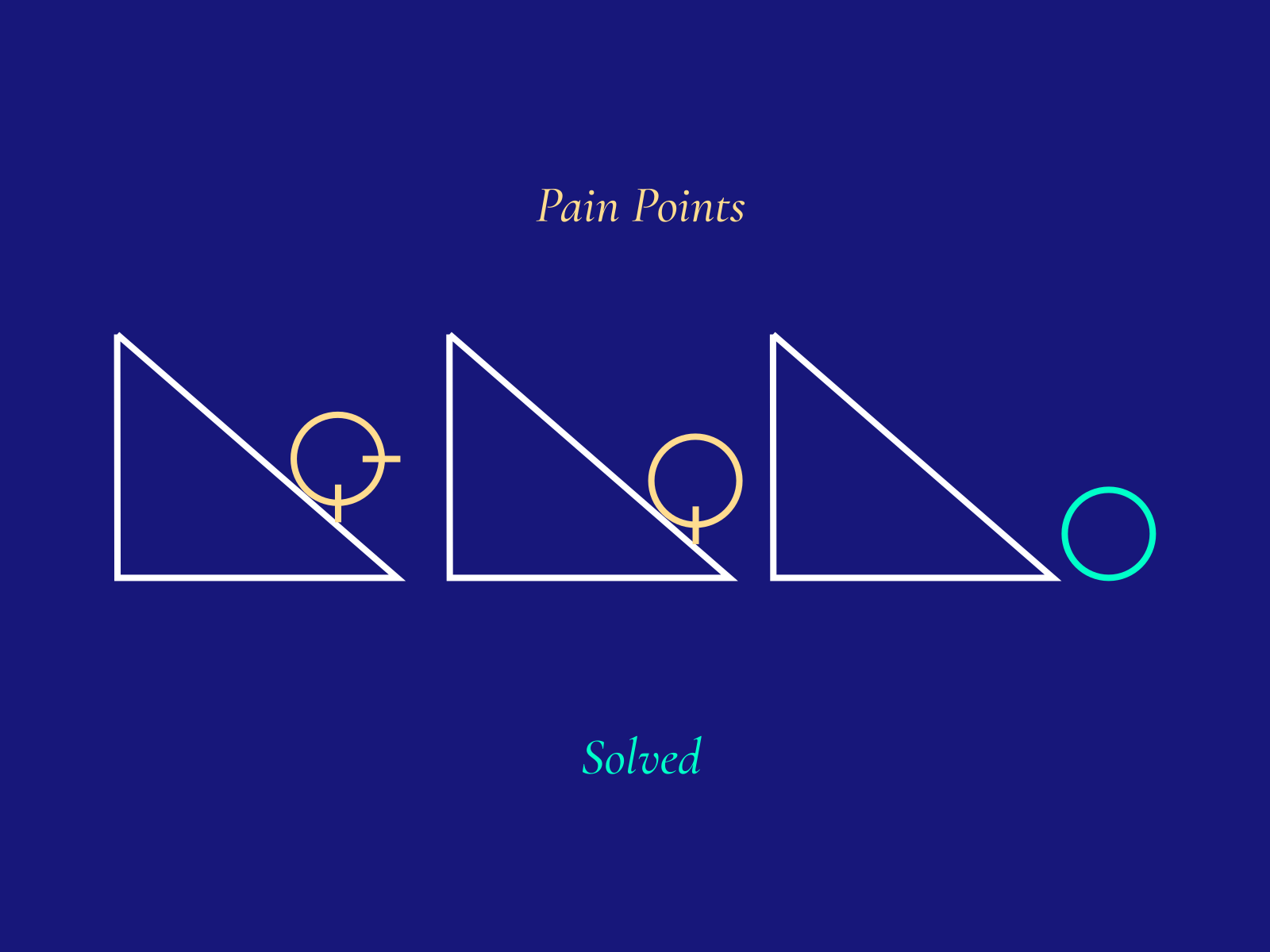
The illustration in the book shows three white right angled triangles in a row, each with a circle on its slope. The first two circles are yellow and snagged on the edge, labelled Pain Points. The last is turquoise and rolls free, labelled Solved. Think of the slope as the client’s business. The pain point is whatever stops it rolling.
Deliverables versus pain points
Clients search for deliverables, but they buy relief. Nobody really wants a logo. They want to stop looking smaller than they are. Nobody wants product photos for their own sake. They want listings that actually sell.
The same goes for most creative work. A website often answers “nobody finds us online” or “our site embarrasses us in meetings”. Blog articles answer “we’re paying too much for ads”. Social media templates answer “posting takes my whole Monday”.
Your website, proposals and sales calls should start with the pain, in the client’s words, and only then get to the deliverable.
Where to find your clients’ pain points
The book’s advice is to research your target audience, identify three issues in their industry, write down how you can help solve each one, and communicate that to potential clients. There are four good places to look.
Ask them
This is the fastest route. The questions in customer discovery questions for freelancers work well here, especially “what’s taking more of your time than it should?” and “what have you tried that didn’t work?”
Listen where they complain
People are remarkably honest in reviews, forums and groups. Read reviews of your clients’ competitors and of the tools they use. Spend time in the industry forums, Reddit threads and Facebook groups where they talk. Skim trade magazines and newsletters and notice which problems the articles promise to fix. Those headlines are pain points someone has already researched for you.
Look back at your own projects
What problem was each past client trying to solve when they first got in touch? Write down the trigger, not the brief. “The investor meeting is in three weeks” is a pain point. “Pitch deck design” is a deliverable.
Check the usual categories
Most pain points fall into four groups: money, time, process and image. Money is costing too much or losing revenue. Time is the owner’s week disappearing. Process is messy work that depends on one person. Image is looking wrong and failing to build trust. Running through each one helps you spot pains you’d otherwise miss.
The book’s hotel example
In the book, the example is a hotel with three problems. Web traffic is solved by writing SEO friendly blogs. Cash flow is solved by creating seasonal pricing. Brand awareness is solved by creating and distributing content on social media.
Look at the second one. Seasonal pricing isn’t a design deliverable. Some pain points sit outside your craft, and that’s fine. You can solve the part you can touch, such as designing the seasonal offers, or point the client to someone better placed. Both build trust, and both show you were listening to their problem rather than selling your service.
Turn a pain point into a message
Once you have your three problems, you need a way to say it. A simple pattern for your website, proposals and outreach: [Audience] struggle with [pain point]. I [solution], so you [result].
Say you’re a web designer who works with independent hotels. You might write: “Independent hotels lose bookings to the big booking sites. I design direct booking websites that make booking with you easier than booking through them, so more of every room rate stays with you.”
It names the audience, the pain and the result, and the deliverable only appears in the middle.
Mistakes to avoid
The first is inventing pains. If you can’t find anyone actually saying it, it may not be real.
The second is listing too many at once. Lead with the biggest one, and keep to three at most on a single page.
The third is promising results you don’t control. Say what your work does, and be honest about what depends on the client.
The last is talking only about your process. Clients care about how you work once they believe you understand their problem, not before.
Questions people ask
What are the main types of customer pain points?
Most fall into money, time, process and image. Checking each type helps you spot pains you might otherwise miss.
How do I find pain points without asking clients directly?
Read reviews of competitors and of the tools your clients use, join the forums and groups where they talk, and notice what industry articles promise to fix.
Should I mention pain points on my website?
Yes, in your clients’ own words. Lead with the main one, show how you solve it, and keep it to three at most.
Try it in 15 minutes
- Choose your target audience.
- Write down three problems they face, using at least one of the sources above.
- Next to each, write how your service helps solve it.
- Turn the strongest one into a single sentence using the pattern above.
That sentence is a strong candidate for your homepage headline.
All Laid Back Freelancing lessons
Cover photo by Ross Sneddon on Unsplash.