

Many freelance problems start with a weak foundation: an offer built on guesses about what clients want. Prices feel random, marketing doesn’t land and every month feels like starting again.
The fix is to treat freelancing as a business and talk to your market before you build. Ask a handful of real clients or prospects a few good customer discovery questions about their challenges, goals and budgets. Their answers become the foundation for your offer, your prices and your marketing.
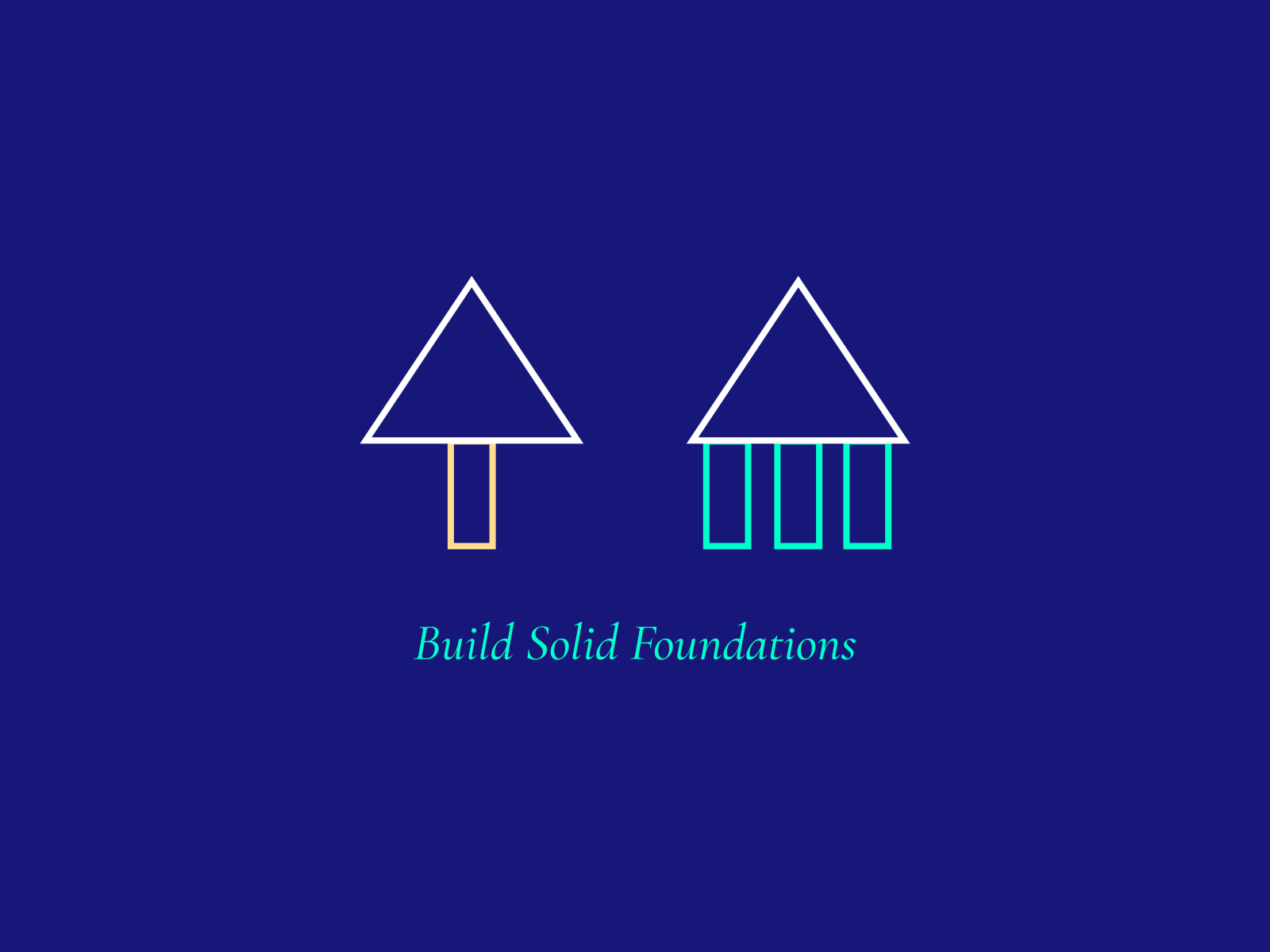
The illustration in the book shows two triangle roofs. One balances on a single thin post. The other rests on four sturdy pillars, with the words Build Solid Foundations. It’s the same roof with a very different chance of staying up. The book’s point is that a solid foundation lets you build much more on top of it. Research is what adds the extra pillars.
Why freelancers skip the foundation
Freelancing usually starts with a skill and a first client, not a business plan. That’s fine for getting going. The trouble comes later, if you never step back and ask what your market actually needs.
Without that step you end up building on one post: one type of project you happened to fall into, priced by guesswork and marketed to everyone. It stands up for a while, until a big client leaves.
The book puts it plainly. Looking at freelancing as a business gives you the advantage to grow massively. Businesses research their customers, and so should you.
What customer discovery means for a freelancer
Customer discovery is a term from the startup world, popularised by Steve Blank. Before building a product, you talk to potential customers to test your assumptions.
For a freelancer it’s simpler. You have short conversations with people who could hire you and you listen far more than you talk. You’re not pitching. You’re learning their language, their problems and what they’d pay to have those problems solved.
The questions to ask
The book’s advice is to define your target market and understand their needs and preferences by asking them a series of questions. Its example is a graphic designer talking to small business owners:
- What are the biggest challenges you face as a small business owner?
- What types of marketing materials do you currently use?
- Are you satisfied with the design of your current marketing materials? If not, what would you like to see changed?
- What are your goals for your business in the next year?
- How much are you willing to spend on design services?
Those five cover a lot of ground: problems, current habits, satisfaction, goals and budget. You can adapt them to almost any creative service by swapping the subject. A copywriter asks about their website and emails. A photographer asks about the images they use now.
Going a little deeper
If you want more, add questions that ask about the past rather than the future. People are poor at predicting what they’ll buy and quite good at describing what they did. Ask when they last tried to fix the problem and what happened, what they’ve tried that didn’t work, and how they usually find someone to help. It’s also worth asking who else is involved in the decision and what would make them trust a freelancer with the job.
Pick five or six questions in total. A short conversation where you listen properly is worth more than a long questionnaire.
How to run the conversations
- Find five people who match the clients you want. Past clients, LinkedIn contacts, local businesses and members of a community you belong to all work.
- Ask for fifteen minutes, not a meeting. Something like: “I’m researching how small businesses handle their design. Could I ask you a few questions? No sales pitch.”
- Write down their exact words. The phrases people use to describe their problems often become your best website copy.
- Look for patterns after five conversations. A problem that comes up three times is worth building your offer around.
Imagine an illustrator who speaks to five children’s book publishers. Three of them mention the same frustration: illustrators who miss print deadlines. Nobody mentions style. That illustrator now knows what to lead with. The website can promise reliable, on time delivery, and every proposal can include a clear production timeline.
Where it goes wrong
The biggest mistake is pitching during the conversation. The moment you start selling, people stop telling you the truth and start being polite.
Leading questions do the same damage. “Don’t you think good design matters?” gets a friendly yes and no useful information. Keep questions open and neutral.
Be careful about only asking friends. They’ll be kind, and you need honest. Friends of friends and past clients are usually a better mix.
Finally, don’t treat it as a one off. Markets shift. A few conversations every quarter keep the foundation solid.
Try it in 15 minutes
- Write one sentence describing the clients you want to learn about.
- Choose five questions from this article and adapt them to your field.
- List five people you could ask.
- Send the first message.
By the end of the week you could have your first real answers, and a much firmer place to build from.
All Laid Back Freelancing lessons
Cover photo by Roger Starnes Sr on Unsplash.