

Most freelancers sell one thing at one price. When a client can’t afford it, the conversation ends there, or the price quietly drops.
There’s a simpler way to package freelance services. Take one service and offer it at three levels of involvement: do it yourself, consulting and done for you. Every budget gets an answer, and your full service finally looks like what it is: the premium option.
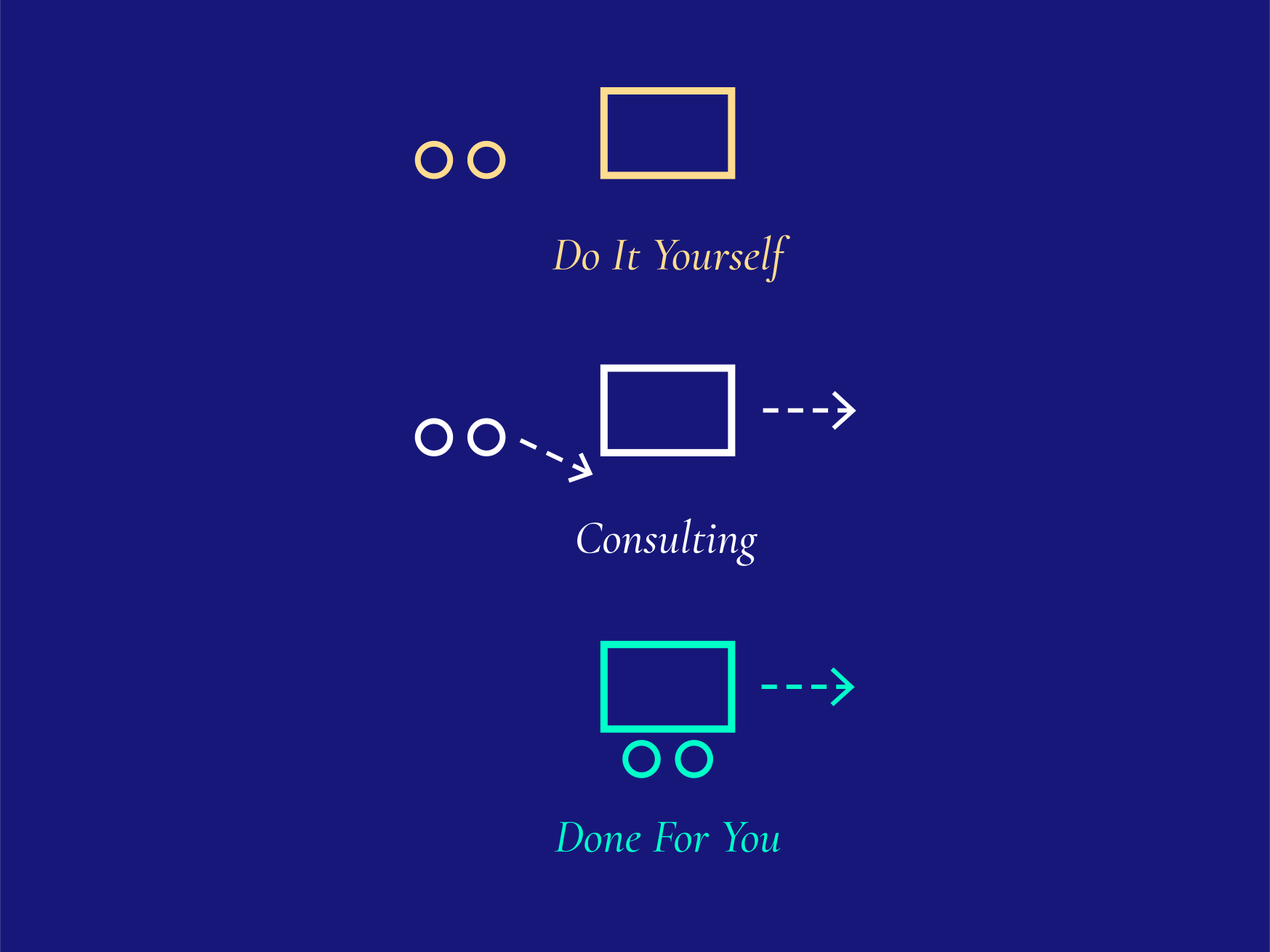
The illustration in the book shows the idea with a box and two small circles. The box is the work. The circles are the client. In the first row the client sits beside the work and handles it alone. In the second, a dashed arrow shows you pointing the way while they do the moving. In the last row, you carry the work for them.
The three levels
Do it yourself
This is the lowest level of engagement: a template, a guide, a checklist or a course that clients can use without you. You make it once and sell it many times, so the price can be low and your time per sale is almost nothing.
It suits clients with small budgets, people at the very start of their business, and anyone who likes to do things themselves.
Consulting
Here you don’t implement anything. You give expert advice based on your research and experience, in a workshop, an audit, a strategy session or a review. The client, or their team, does the work.
Consulting suits companies with an in house team, and clients who need direction more than extra hands.
Done for you
You do everything. This is the full project, and it carries the highest price. Placed next to the other two levels, that price makes sense straight away, because it’s the option that costs the client the least time and effort.
What it looks like in practice
The book’s example is branding. The do it yourself level is a brand guidelines template. Consulting is a branding workshop. Done for you is the complete branding project.
The same pattern works for almost any creative service. A web designer might sell a website planning workbook, a one hour site review with a prioritised list of fixes, and a full design and build. A photographer might offer a guide to shooting products on a phone, a planning session with a shot list, and a complete shoot with editing. A copywriter could sell a homepage template, a copy audit, and the finished website copy.
Notice that the first two levels often already exist inside your process. The planning workbook is the document you send every new client anyway. The audit is the first week of a full project. You’re packaging work you already do.
How to price the levels
Price each level by the value it gives and the effort it saves the client, not by your hours.
The do it yourself level can sit at an easy, impulse price. Consulting gets a fixed fee for a clearly defined session or audit. Done for you is your full project price, usually many times the consulting fee.
The gaps between the levels should feel obvious. You want the client choosing how much help they need, not hunting for a bargain.
Why three levels work so well
More people can say yes. Someone who can’t afford a full project can still buy the template or book the workshop, and that’s a relationship you wouldn’t otherwise have.
Clients also tend to move up. A do it yourself buyer who gets stuck is a natural consulting client. A consulting client who runs short of time will often ask you to just do it for them.
And there’s a laid back bonus. Your do it yourself products keep earning while you’re not working.
Where it goes wrong
The most common mistake is letting the consulting level turn into a full project in disguise. Write down exactly what’s included: how long, what format, what the client receives at the end.
The second is building a product nobody asked for. Start with the template or guide you already make for every client, not a brand new course.
Finally, protect the done for you level from scope creep. Define the deliverables and the number of revisions, or a fixed price slowly turns back into hourly work.
Questions people ask
What should a freelance package include?
A clear result, a list of deliverables, the number of revisions, a timeline and a price. If any of those are missing, the package tends to drift into open ended work.
How many packages should I offer?
Three levels per service is plenty. More options make it harder for clients to choose, not easier.
What’s the difference between done for you and done with you?
Done for you means you do the work. Done with you, the consulting level here, means you guide while the client or their team does the work.
Try it in 15 minutes
- Pick the service you sell most often.
- Write down a do it yourself version. Look for something you already explain or make for every client.
- Write a consulting version with a clear format, such as a call, workshop or audit, and what the client gets at the end.
- Describe the done for you version and list exactly what’s included.
You now have a three level offer. Put it in your next proposal and see which level the client chooses.
All Laid Back Freelancing lessons
Cover photo by Emma Smith on Unsplash.