
Yes, freelancers need a personal brand. But most need far less fame than they think. Being known by the right fifty people usually beats being seen by fifty thousand strangers.
So the useful question isn’t how to become famous. It’s how visible your business actually needs to be. Decide that, build exactly that much, and protect the calm that made you go freelance in the first place.
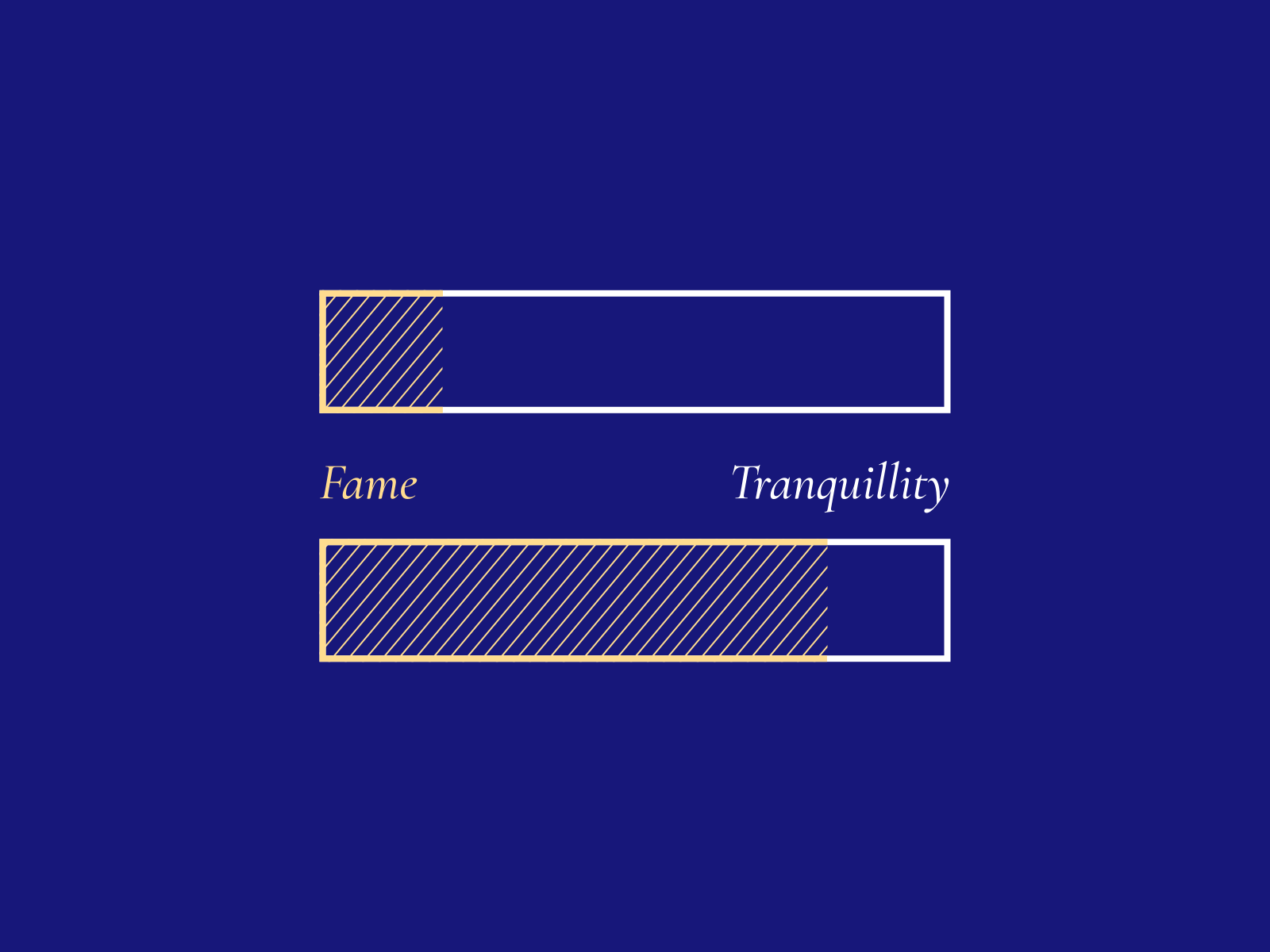
The illustration in the book shows two bars, one labelled Fame and one labelled Tranquillity. As the yellow hatching fills the Fame bar, it empties from the Tranquillity bar. You can move along the scale, but you can’t fill both. The book’s point is that fame is often treated as the ultimate sign of success, yet it can rob you of peace. It should be pursued with caution.
What visibility costs a freelancer
Attention brings messages, opinions, comparison and a constant pressure to keep performing. The book notes that the spotlight and the scrutiny that comes with it have hurt many famous people. You don’t need to be a celebrity to feel a smaller version of that.
For a freelancer, the cost is mostly time and energy. Every hour spent making content, replying to comments and checking numbers is an hour not spent on client work, on your craft or on rest. That trade can be worth it. It just shouldn’t happen by accident.
Why the pressure feels so strong for creatives
Every platform rewards posting more. Peers with big followings seem to get all the good work. It’s easy to conclude that the only way to win clients is to become an influencer as well as a designer, writer or photographer.
In reality, plenty of well paid freelancers are barely visible online. Their work comes from referrals, agencies and a small circle of clients who trust them. Visibility is one route to clients. It isn’t the only one.
Start with why you want to be known
The exercise in the book asks you to reflect on your motivation. Why would you want to become well known? Are you looking for recognition for your work? Do you want a platform to speak up for a cause?
Be honest, because each answer needs a very different amount of visibility.
| Your motivation | What it really needs |
|---|---|
| More and better clients | Visibility with your target audience only |
| Higher prices | Proof and authority: case studies, results, a clear point of view |
| Recognition from peers | Awards, talks and communities, not mass reach |
| A platform for a cause | Regular public content, and accepting the trade off |
| Selling products or courses | Real reach, which means real time spent on content |
If your honest answer is more and better clients, you probably need to be visible to a few hundred people, not everyone.
Choose your level of visibility
It helps to think of visibility as three levels and pick one on purpose.
The first is quiet. You have a clear website, a portfolio and a tidy LinkedIn profile, and work comes from referrals and outreach. It’s the lowest noise option and suits many experienced freelancers perfectly well.
The second is known in a niche. You share case studies or articles aimed at one audience, show up in one or two communities and give the occasional talk. It’s enough for the right clients to find you and trust you, without your whole life becoming content.
The third is public. Frequent content, a large following, often products or courses. It brings the most reach and costs the most calm.
A plan for being known in your niche
In the book, the example list reads like a sensible plan for the middle level:
- Develop skills
- Create a strong personal brand
- Build a following
- Network and build relationships
- Collaborate with others
- Create positive impact through the brands I work with
Notice the order. Skills come first and following comes third. And the last line puts the spotlight on the work and the brands you help, not on you.
Imagine a copywriter who wants better business clients but hates posting every day. They might share one before and after rewrite on LinkedIn each week, write a guest article for a marketing blog once a quarter and have coffee with someone at an agency once a month. That’s a couple of hours a week. Enquiries start to come from people who have read their work, and that’s all the fame the business needs.
Mistakes to avoid
The easiest trap is copying a public creator’s routine when you only need to be known in a niche. Their schedule is built for a different goal.
Another is measuring followers instead of enquiries. One right client is worth more than a thousand likes.
Quiet is fine, but invisible isn’t. Clients still need to find proof of your work, so keep your website and portfolio current even if you never post.
And don’t forget the cost. If visibility starts eating into rest and craft, move back along the scale. You’re allowed to.
Try it in 15 minutes
- Write one honest sentence about why you want to be more visible.
- Use the table above to see what that motivation really needs.
- Choose a level: quiet, known in a niche or public.
- Write down the weekly time you’re willing to give to visibility, and the one or two activities you’ll spend it on.
That’s your personal brand plan, sized to the business you actually want.
All Laid Back Freelancing lessons
Cover photo by Neil Thomas on Unsplash.