

It can feel as if thousands of people sell exactly what you sell. That feeling causes stress, and it quietly pushes you to lower your prices.
To stand out as a freelancer, you need a reason for clients to choose you that isn’t price. The book calls it a unique competitive advantage, and the quickest way to find yours is to ask the people who already chose you. Their answers usually point somewhere you’d never have looked.
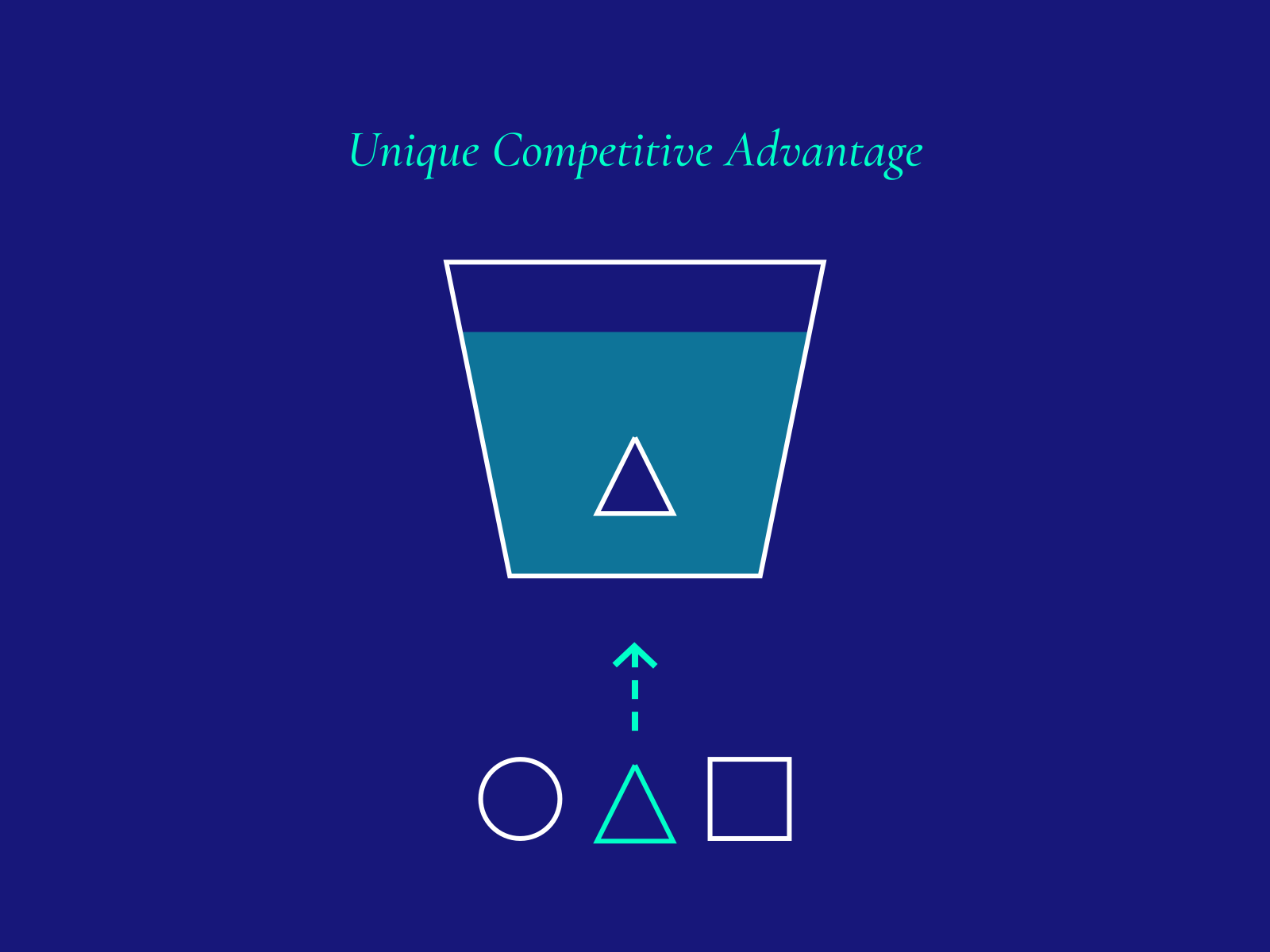
The illustration in the book shows a circle, a triangle and a square sitting in a row beneath a turquoise filled cup. A dashed arrow lifts only the triangle into the cup. Out of all the things you could be known for, one belongs at the top. Your job is to find out which.
What makes an advantage worth having
The book says your offer should be different, unique, sustainable and relevant. Different means clients can tell it apart from the alternatives. Unique means few others can honestly claim it. Sustainable means you can keep delivering it and it’s hard to copy. Relevant means clients actually care.
Run your current pitch through those four tests. “I’m passionate about design” fails every one of them. “Every website comes with a one hour training session so your team can update it themselves” passes most. It’s concrete, it’s useful and not every designer offers it.
Why you can’t guess it yourself
Freelancers tend to assume clients hire them for their craft. Often the real reason is something else entirely. You replied quickly. You explained things clearly. You already understood their industry. You stayed calm when the launch went wrong.
You can’t see these things from the inside, because to you they’re just how you work. Clients notice them straight away, and they’re often the reason they come back.
Ask your clients why they chose you
The book’s advice is simple: talk to your existing clients, figure out why they like your work, and outline your advantage from what they tell you.
In the book, the example email reads like this:
Hi [customer], I would love to know what you like about my services. Is there anything that stands out about my process or work? Have you worked with anyone else, and if so, what makes me different to them?
Send it to five to ten past clients, ideally ones you’d happily work with again. Keep it short and personal, and add a line that shows you remember their project.
If someone offers a call instead, you can go a little deeper. Ask what made them choose you in the first place, what almost stopped them, how they’d describe you to a friend who needed the same work, and what they’d miss if they had to work with someone else. That last question often gets the most honest answer.
Find the pattern in the replies
When the answers come in, lay them side by side and highlight the words that repeat. You’re looking for themes, not compliments.
Imagine a web designer gets replies saying “you explained everything in plain English” and “I never felt lost”. That’s clarity. Another two say “always on time” and “you hit the launch date”. That’s reliability. One more says “you got our industry straight away”, which points to sector knowledge.
The theme that appears most often, and that still passes the four tests, is your advantage. Combine it with your transferable skills, the experience you picked up before or alongside freelancing, and you may find an angle nobody else can claim.
Turn it into one sentence
Once you know what it is, say it plainly. A pattern that works: I help [audience] get [result], and unlike most [type of freelancer], I [advantage].
Say you’re a web designer who worked in hotels for years before going freelance. Your sentence might be: “I help independent hotels get more direct bookings, and unlike most web designers, I’ve worked in hotels, so I know how your guests book.”
Put it on your homepage, in your LinkedIn headline and at the top of your proposals. Use it when someone asks what you do.
Where it goes wrong
The first trap is choosing an advantage clients don’t value. Relevance beats cleverness every time.
The second is claiming what everyone claims. Quality, passion and creativity are expected. They’re the entry ticket, not the advantage.
The third is keeping it in your head. If it isn’t written on your website and in your proposals, it isn’t working for you.
And the last is competing on price instead. Being the cheapest is an advantage anyone can take from you tomorrow.
Questions people ask
What is a unique selling point for a freelancer?
The reason a client would choose you rather than another freelancer, stated clearly. It should be different, unique, sustainable and relevant to the client.
How do I ask a client for feedback by email?
Keep it short and personal. Ask what they liked, what stood out about your process and how you compared with others. The template above is a good start.
What if I don’t have past clients yet?
Start with your transferable skills and any background that helps you understand a type of client. Then ask your first clients the same questions once projects finish.
Try it in 15 minutes
- List five past clients you enjoyed working with.
- Personalise the email above for each one, with a line about their project.
- Send them all.
- Set a reminder for one week from now to collect the replies and look for the pattern.
By next week you’ll have your advantage in your clients’ own words.
All Laid Back Freelancing lessons
Cover photo by Joaquin Arenas on Unsplash.