

Interests outside your field can look like distractions. They aren’t. Everything you learn adds up, and together it gives you a perspective nobody else has.
The transferable skills that matter most for freelancers often come from the least obvious places: a hobby, a side job, an odd chapter of your career you rarely mention. Write them all down, work out what each one taught you, and put the most relevant skills where clients will see them, in your portfolio, your CV and your website.
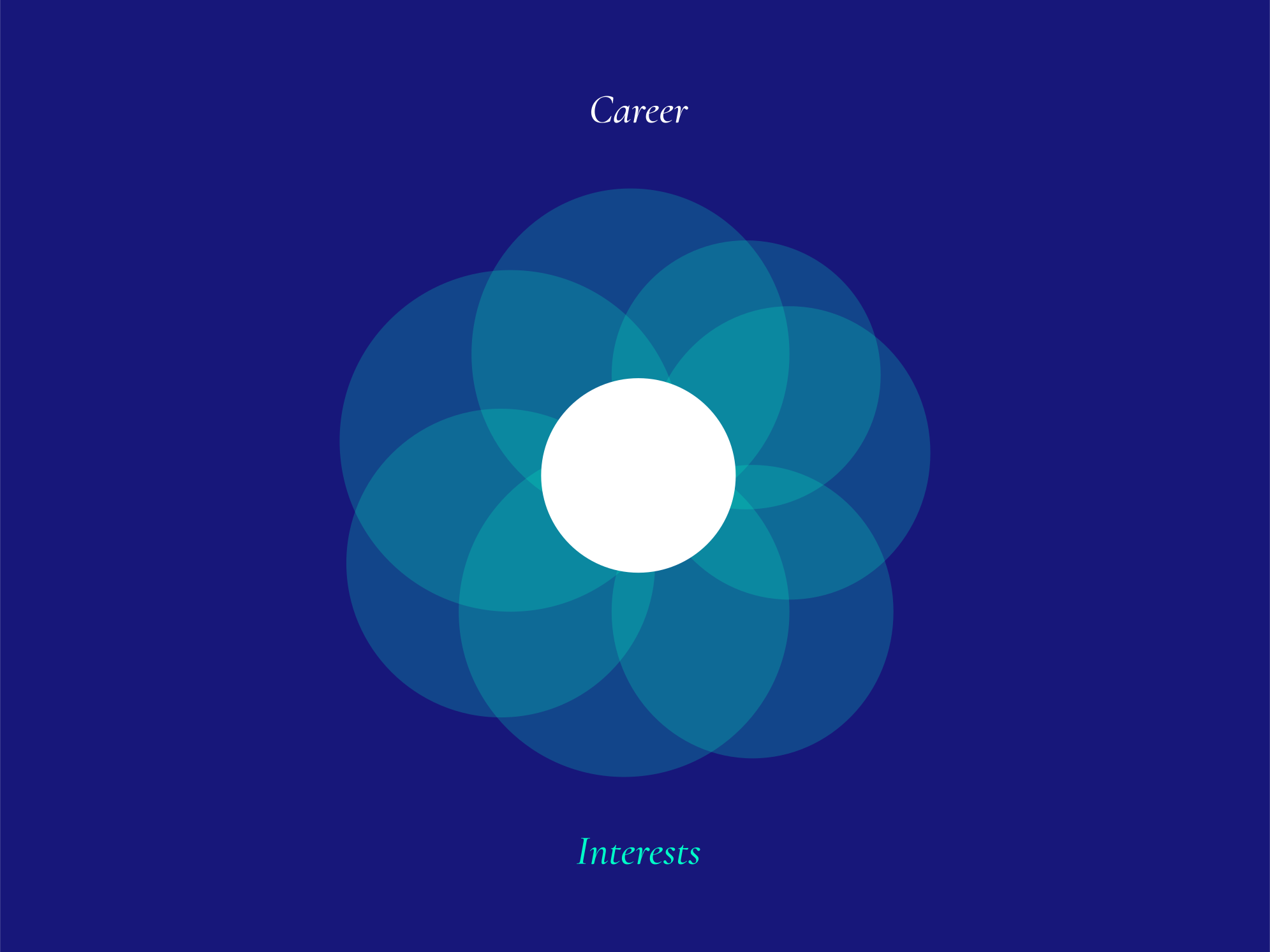
The illustration in the book is a flower made of overlapping translucent circles around a solid white centre, with Career written above it and Interests below. Each circle is a different part of your life. Where they overlap, the colour deepens. The white centre is where all of them meet: you, and the mix of experience only you bring to a project.
Why your mix matters when you sell creative work
Clients can find a competent designer, photographer or writer in seconds. What makes them remember one is usually something extra.
Think of a designer who used to be a chef and understands how restaurants work, a copywriter who spent years in a lab and can explain science plainly, or an illustrator who climbs and draws mountains properly. Each of them has a reason to be chosen that has nothing to do with being the most skilled person in their field.
That kind of mix is hard to copy. It’s also often invisible, because most freelancers leave it off their website as not relevant.
Hard skills get you hired, soft skills get you rehired
Hard skills are the craft: layout, retouching, editing, animation. Soft skills are how you work: communicating, negotiating, staying calm, leading a project. Clients pay for the first and come back for the second.
Hard skills usually come from training and practice in your field. Soft skills come from everywhere else, which is why the rest of your life is worth looking at.
What the book’s example shows
In the book, the example list covers three areas:
- Interests and hobbies: music, drumming, DJing, cooking, surfing, boxing
- Jobs: chalet host, drummer, creative director, graphic designer, brand manager
- Soft skills: communication, motivation, negotiation, critical thinking, leadership
Look at where the soft skills could come from. A chalet host learns to keep demanding guests happy when things go wrong. A drummer learns timing and how to hold a group together. Boxing teaches you to stay composed under pressure. A brand manager learns to negotiate between people who all want different things. Every one of those shows up in client work, even though only some of the jobs look like a creative career.
Where to use what you find
Your about page is the obvious place. One or two sentences that connect a past life to how you work now are enough. Something like “Ten years of hosting guests taught me to read what people need before they say it” does more than a list of adjectives.
Case studies are the next place. Mention the skill where it changed the result, such as the shoot that ran smoothly because you’d once managed a kitchen through a busy service.
On your CV or LinkedIn profile, add a short soft skills section with evidence for each one. And look at your interests when you think about niches. They may point to an industry you understand better than most, which is the idea behind how to test freelance niches.
Say you’re a UX designer who spent four years as a nurse before changing career. A headline that reads “UX designer, five years of experience” puts you alongside thousands of others. “UX designer who spent four years on hospital wards”, with healthcare projects shown first, makes you the obvious choice for health tech clients. Same person, same skills, very different first impression.
Mistakes to avoid
Listing hobbies without a point is the most common one. “I like cooking” means nothing to a client. “Cooking taught me to plan backwards from a deadline” does.
Don’t hide a past career because it seems unrelated or unglamorous. A job you’re not proud of often holds your most valuable soft skills.
Resist claiming every soft skill going. Pick the three you can back up with a real example.
And don’t force it. If a hobby doesn’t connect to your work, leave it off your site. It can still feed your creativity in the background.
Try it in 15 minutes
- Write down every interest, hobby and job you’ve had, including the odd ones.
- Next to each, write one thing it taught you that a client would value.
- Circle the three strongest.
- Write one sentence for your about page that uses at least one of them.
Put that sentence on your website today. You can polish it later.
All Laid Back Freelancing lessons
Cover photo by Matthijs Smit on Unsplash.