

When everyone in your field markets the same way, clients can’t tell anyone apart. Contrarian marketing means deliberately doing the opposite of the crowd, but only where the opposite serves you better.
For a freelancer it starts with a simple check. Which tools, tactics and goals are you using because they’re right for you, and which because everyone else is? Where the crowd all swims one way, the other direction is often empty, and much easier to be seen in.
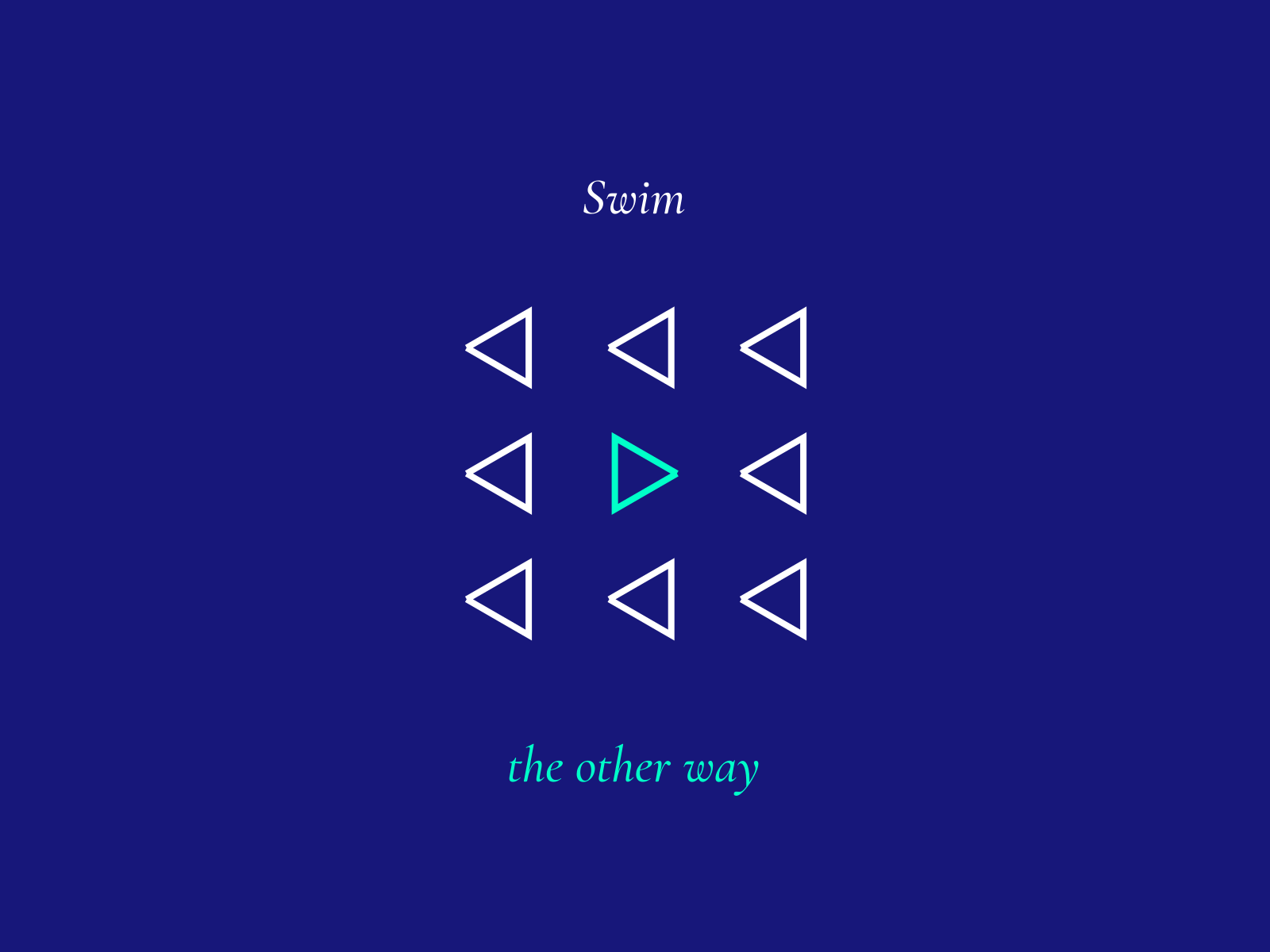
The illustration in the book shows a grid of white triangles, all pointing left. In the centre, one turquoise triangle points right, with the words Swim the other way. Your eye goes straight to the one that’s different. That’s the whole idea in a single picture.
Why trends pull freelancers in
The book puts it well: we get so caught up in trends and the latest fad that we forget to ask whether they’re right for us, or whether they match what we actually need.
A new platform appears and everyone rushes to post there. A style takes over the design feeds. A pricing model or productivity system becomes the thing everyone recommends. Following feels safe, because nobody gets blamed for doing what everyone else does.
The cost is that you blend in. And the trend may not fit your clients, your work or the way you want to live.
Check what you chose and what you copied
The book asks you to stop and think about the tools, actions and goals you use in your business. Is this what you really need? Or could doing the exact opposite give you an advantage over everyone else?
A practical way to answer is to look at four areas: your marketing channels, your style, your pricing and your process. For each one, write down what you do now and ask honestly whether you chose it or copied it. Then write what the opposite would look like.
Say you’re an illustrator who posts on Instagram every day because everyone does. The opposite might be a longer monthly email to past clients. If you charge by the hour because that’s what you saw others do, the opposite is fixed price packages. If you offer unlimited revisions to seem friendly, the opposite is two clearly defined rounds.
Not every opposite is better. The point is to make each choice deliberately rather than by habit.
Decide what you want from work
The book’s exercise is one question: what do I want to do at work?
In the book, the example answers read:
- Work on projects that help the environment.
- Work with clients who are future oriented.
- Work on strategy.
- Work with companies that make 1 million in turnover a year.
- Do high level work and outsource the rest.
Put your own answers next to your list of habits. A tactic that everyone uses but doesn’t move you towards these things is a good candidate to drop. A tactic nobody in your field uses, but that leads straight to the work you want, is your other way.
What swimming the other way can look like
Being slow in a fast market is one option. If everyone promises a 48 hour turnaround, a web designer could offer a considered two week process with research included, for clients who want it done properly.
Going offline in an online market is another. If every photographer markets on social media, a photographer could hold small print exhibitions in the cafés their ideal clients already visit.
Some freelancers choose fewer clients on purpose. While everyone else tries to look busy, saying openly that you take on four projects a quarter signals focus and makes your time feel valuable.
And there’s plain language in a market full of jargon. When every agency talks about synergy and solutions, a copywriter who simply writes like a person stands out at once.
When not to swim the other way
Being contrarian isn’t a goal in itself. Don’t drop something just because it’s popular.
If a channel genuinely brings your best clients, keep it. If clients expect a basic standard, such as a clear contract, tidy invoices or secure handling of their files, meet it. And if the opposite would only be different, not better for your clients, skip it.
Where it goes wrong
The most common mistake is being different without a reason. Clients need to see why your opposite choice is good for them.
Another is changing everything at once. Pick one area, test it for a month and see what happens.
There’s no need to mock the trend either. You can go the other way without criticising people who don’t.
Finally, tell people. A contrarian choice only helps your marketing if clients know about it, so put it on your website and in your proposals.
Try it in 15 minutes
- Write down what you do now for channels, style, pricing and process, and mark each one as chosen or copied.
- Answer the question “what do I want to do at work?” in four or five lines.
- Pick one copied habit that doesn’t serve your answers.
- Write what you’ll do instead for the next month.
One deliberate change is enough to start standing apart from the crowd.
All Laid Back Freelancing lessons
Cover photo by Lance Anderson on Unsplash.