

There will always be someone with a better portfolio, a lower price or sharper skills. You can’t win that race, and you don’t need to.
The way to stop comparing yourself to other freelancers is to change what you measure. Write down what success means for you, then judge your week against that list instead of against someone else’s highlight reel.
Watching the competition is useful. It only becomes a problem when watching turns into scoring yourself on their terms.
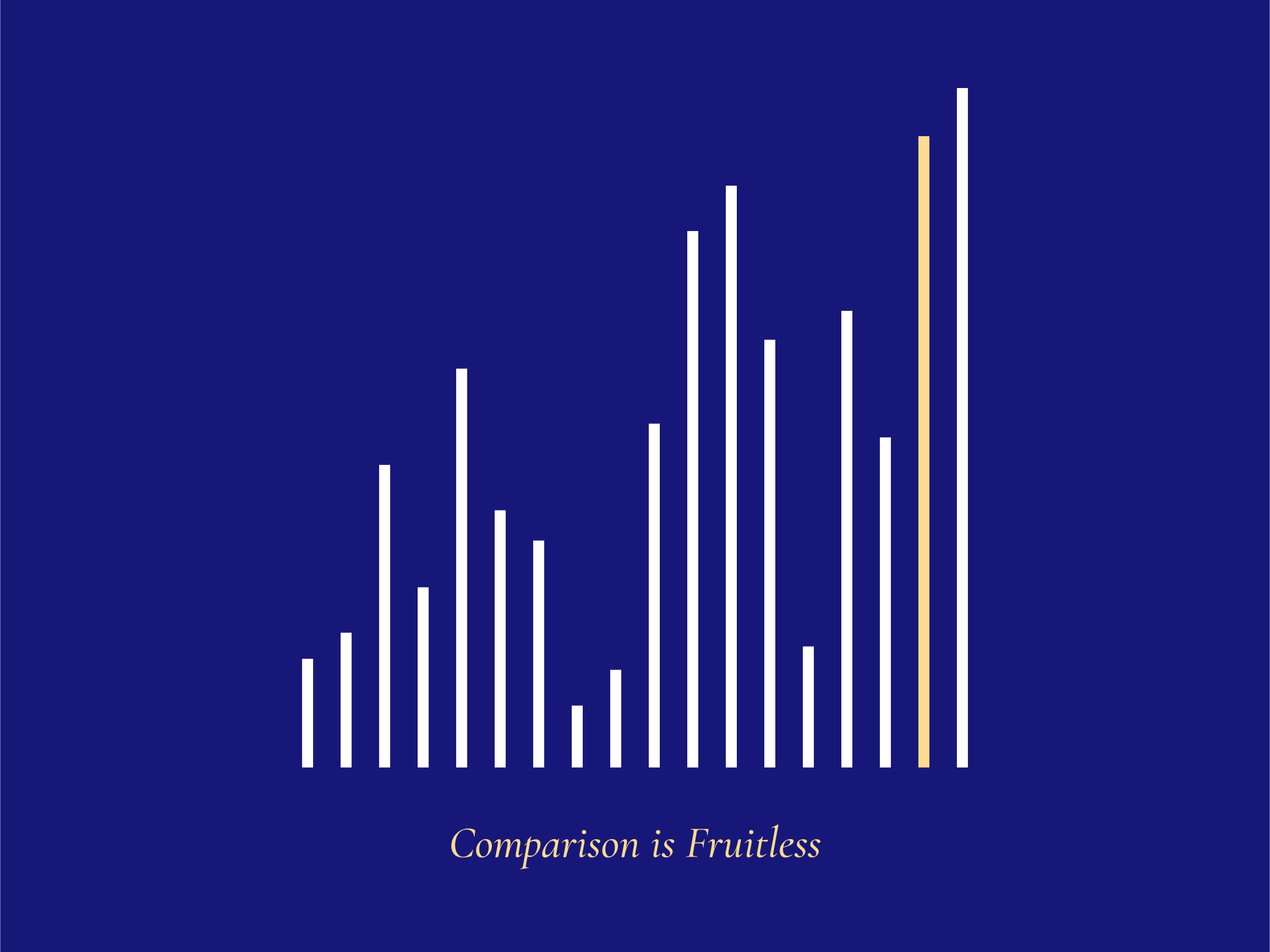
The illustration in the book is a row of white bars, all different heights, with one pale yellow bar standing among them. The yellow bar isn’t the tallest, and it doesn’t need to be. Every bar is measuring something different, so lining them up tells you nothing. The yellow bar is you, and the only fair comparison is with the bar you were last month.
Why comparison hits creatives so hard
Creative work is public by design. Designers post finished projects, illustrators share every sketch, photographers fill their feeds with their best frames. You see the final result of hundreds of other people’s work and none of their dull weeks, lost pitches or unpaid invoices. It’s a heavily edited sample, and you’re comparing it with your unedited life.
The numbers you can see don’t tell you much either. Someone’s portfolio was built for their clients. Their price fits their costs. Their pace fits their life. None of that tells you whether your business is working.
What clients actually hire you for
The book makes a simple point: your perspective and your availability may be all you need to win the job.
Clients don’t go looking for the best freelancer in the world. They hire the one who understands their problem, can start soon and feels right to work with. A web designer who has run a small shop understands an online store owner in a way a more decorated designer might not. A photographer who is free next Thursday beats a famous one who is booked until spring.
That’s why scoring yourself against the most visible people in your field is so misleading. They’re not competing for the same clients, at the same moment, with the same story.
Build your own scoreboard instead
The exercise in the book asks four questions about what matters to you. Treat the answers as your scoreboard, the measures you check instead of other people’s numbers.
- What really matters most to me in life?
- What would bring more happiness into my life?
- What does my ideal day look like?
- What are my passions and dreams?
In the book, the example answers read: freedom; healthy relationships, great work and playing more; meditate, yoga, surf, work for two hours, play music and eat with friends and family; create a self sustaining business and help other businesses succeed.
Look at what isn’t on that list. No follower counts, no awards, nothing about how busy anyone else looks. Once your own measures are written down, a peer’s big launch becomes interesting news rather than a verdict on you.
Turn your answers into weekly checks
Answers only help if you look at them. So pick three things from your list that you can actually see in a normal week, and give each one a simple target.
Imagine an illustrator whose ideal day includes two hours of personal drawing. Their scoreboard might be four hours of personal work this week, four out of five days finished by 5pm, and one enquiry from the kind of client they want. Those three numbers say more about whether the business is working than any scroll through another illustrator’s feed.
Check the scoreboard at the same time every week. Friday afternoon works well, because it gives you the weekend to notice what needs to change.
When comparison is actually useful
Not all comparison is fruitless. Looking at other freelancers is healthy when you’re after information, not judgement.
Pricing research is one example. What do people with similar experience charge for a similar result? Use the answer to sense check your own prices, not to undercut anyone. Gaps are another. If nobody in your area offers a particular service, that may be where your advantage sits, which is the subject of how to find your unique selling point. And a peer’s case study can show you a better way to present your own work.
There’s a quick test for which kind of comparison you’re doing. After looking at someone’s work, do you have a next step, or just a bad feeling? A next step means it was research. A bad feeling means it’s time to close the tab.
Where it goes wrong
The most common trap is measuring things you can’t see. You don’t know someone’s hours, who helps them, or how much they had saved when they started. Compare only what you can verify.
The second is comparing your start with their middle. Someone ten years in had a first year too, and it probably looked a lot like yours.
Some people try to ignore the feeling instead of removing the source. If one account always leaves you flat, unfollow it for a month. You can always come back.
Finally, don’t turn the scoreboard into a new stick to beat yourself with. It’s there to guide decisions, not to give you another reason to feel behind.
Try it in 15 minutes
- Set a timer for 10 minutes and answer the four questions. Keep each answer to a line or two.
- Circle the three answers you could notice in a normal week.
- Turn each one into a simple target, like the illustrator’s scoreboard above.
- Put the three targets somewhere you’ll see them every Friday: a note, a calendar reminder or the top of your to do list.
Next Friday, check your scoreboard before you open social media.
All Laid Back Freelancing lessons
Cover photo by Austris Augusts on Unsplash.