

There’s an endless debate about whether a freelancer should be a specialist or a generalist. The honest answer is that neither is better. Specialists go deep in one area and usually find it easier to charge more and get referred. Generalists go broad and handle loosely defined projects that need many skills.
The right choice depends on your strengths, your market and what you enjoy. Start by looking at what you’ve actually done, then decide where you want to go on purpose.
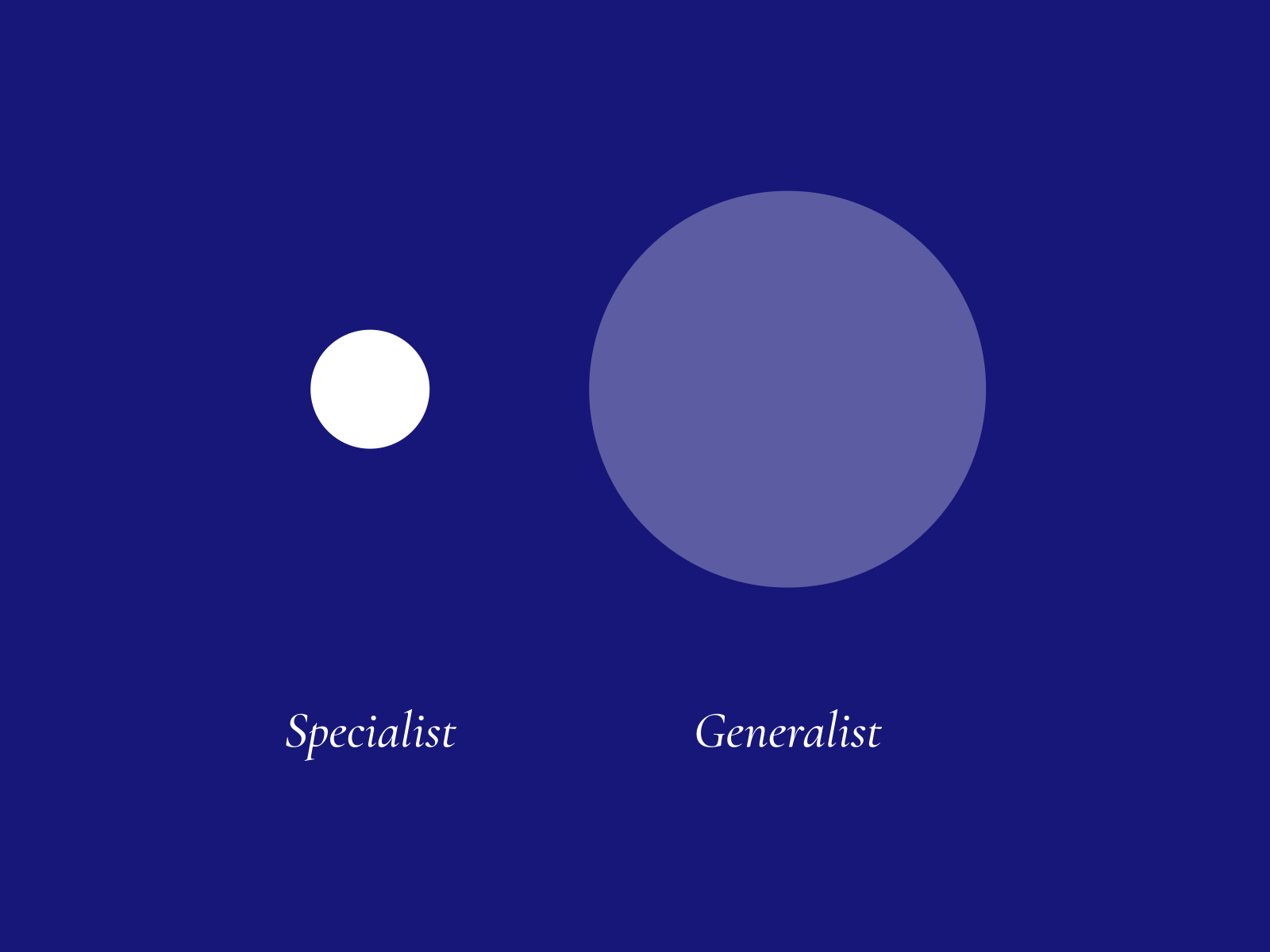
The illustration in the book shows a small, solid white dot labelled Specialist beside a large, pale circle labelled Generalist. The dot covers very little ground, but it’s at full strength. The circle covers far more, but it’s thinner. You could read it as the same amount of energy, spread in two different ways.
Depth or breadth
The book describes it simply. Generalists have a wide range of skills, which is breadth. Their tasks tend to be loosely defined and need a broad range of expertise. Specialists focus on a particular area, which is depth, and usually a specific niche.
| Specialist | Generalist | |
|---|---|---|
| Typical pitch | “I design packaging for craft drinks brands” | “I help startups with brand, web and product design” |
| Pricing | Easier to charge more for proven depth | Value comes from saving clients a whole team |
| Finding clients | Fewer clients, but they find you and refer each other | More possible clients, harder to stand out |
| The work | Repeatable and efficient, can get repetitive | Varied, more learning, more switching between tasks |
| Risk | Exposed if the niche shrinks | Exposed to cheaper all rounders |
Both columns have real advantages. What matters is which set of trade offs suits you.
Find out which you are now
The exercise in the book starts with your own history. List all the jobs you’ve done as a freelancer, write down what you contributed to each project, then work out your role. If you’ve worked across many areas, you have more breadth. If you’ve focused on one or two, you have more depth.
In the book, the example entry reads: Project X, contributions web design, UX design and branding, role generalist.
Do this for your last eight to ten projects and add the fee next to each one. Patterns appear quickly. You might call yourself a generalist and find that most of your income comes from one kind of work. Or you might think of yourself as a specialist and notice how often clients ask you for everything else too.
Then decide which you want to be
Your past shows where you are. Five questions help you choose where to go.
- Where does your best income come from? If one type of project clearly pays better, that’s a specialism waiting to happen.
- What do clients refer you for? Referrals show how other people already see you.
- What gives you energy? Some people love repetition and mastery. Others need variety to stay creative.
- How big is the market? A very narrow niche with too few clients can’t sustain you, so check there are enough.
- Who’s your competition? In a crowded general market, specialising helps you stand out. In a small town or a niche industry, being the one person who can do it all may be the advantage.
You can be both
Plenty of freelancers combine the two: deep in one area and broad enough to connect it to the rest of a project. A web designer who specialises in hotels but can also direct photography and write copy is a specialist to the hotel industry and a generalist on each project.
Another common route is to explore as a generalist first, then specialise once you see what works. That’s the approach in how to test freelance niches.
Imagine a designer who maps ten projects and finds four websites, three brand identities, two pitch decks and one app. On paper that’s a generalist. But the pitch decks paid the most per day and both came from founder referrals. Keeping the broad skills while leading with pitch decks and branding for early stage startups gives a specialist message backed by generalist range.
Where it goes wrong
A common mistake is specialising in a skill nobody buys on its own. It’s usually stronger to specialise in a problem or an industry than in a single tool.
The opposite mistake is calling yourself a generalist just to avoid choosing. Breadth is only a strategy if you sell it as one, for example as one person instead of three.
Don’t treat the decision as permanent either. Many freelancers move between the two over a career.
And don’t ignore enjoyment. The most profitable position won’t last long if it bores you.
Questions people ask
Do specialists earn more than generalists?
Specialists often find it easier to charge more because their expertise is easy to see and easy to refer. Generalists can earn just as well when they sell their breadth as a benefit.
Can I be both a specialist and a generalist?
Yes. Many freelancers specialise in an industry or a problem and use broad skills on each project. Clients see a specialist and the project gets a generalist’s range.
Should a new freelancer specialise straight away?
Not necessarily. Exploring broadly for a while, then specialising in what works, is a common and sensible route.
Try it in 15 minutes
- List your last eight to ten projects.
- Next to each one, write your contributions and the fee.
- Mark each project as depth or breadth.
- Answer the five questions above in a line each, then finish this sentence: for the next year, I’ll position myself as…
You’ll come away knowing where you stand and which direction you want to grow in.
All Laid Back Freelancing lessons
Cover photo by Maciej Karoń on Unsplash.