
You probably have the same ingredients as every other designer: the same software, the same references, the same feeds full of the same work. What makes your result different is your personal touch, your experience and your perspective. The book calls creativity the ingredient that makes things unique and magical.
The catch is that you rarely reach that part of yourself on the first try. The most reliable brainstorming technique is volume. Come up with far more ideas than you think you need, don’t judge them yet, and use methods that pull you away from the screen.
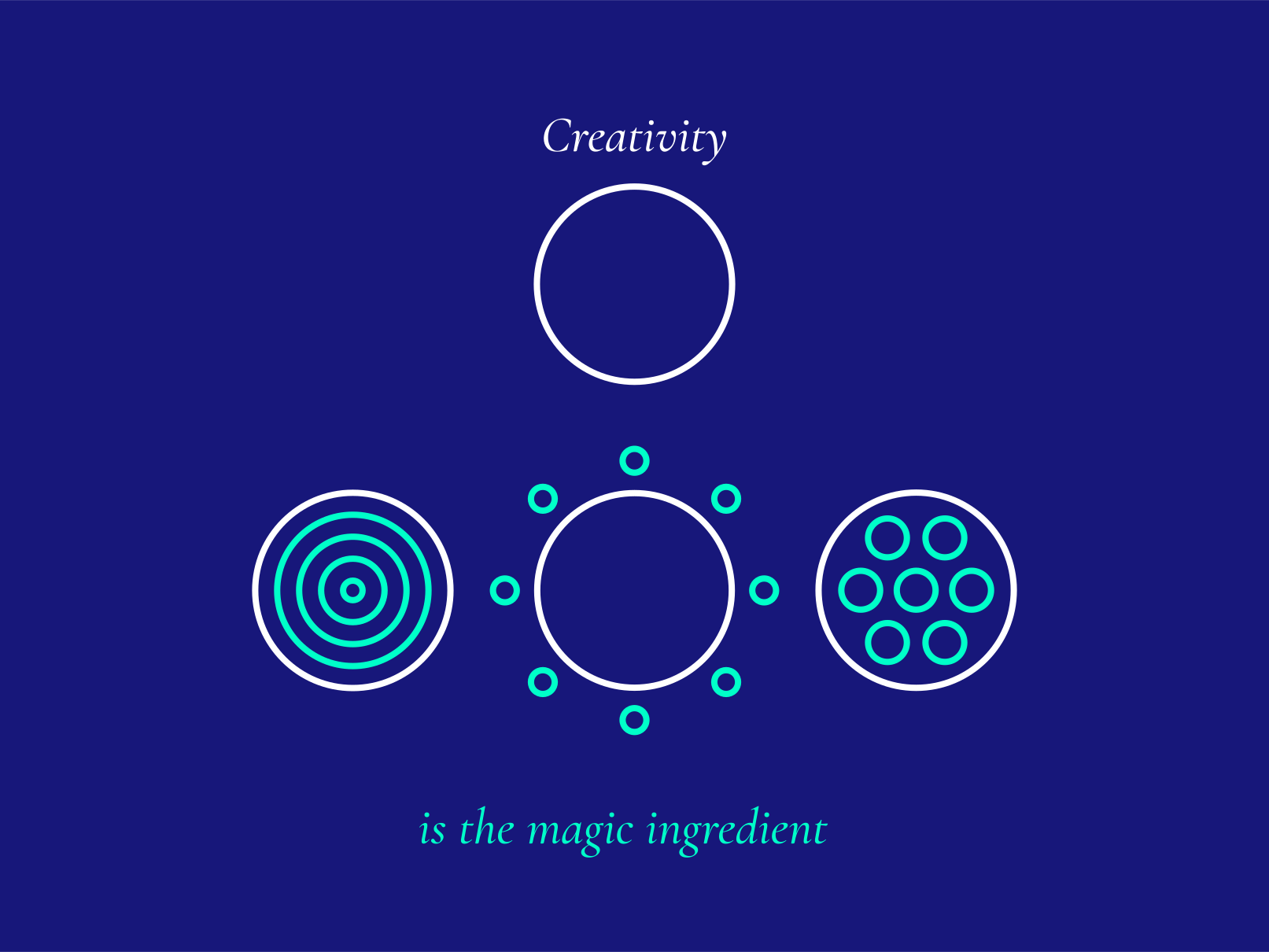
The illustration in the book shows a plain white circle labelled Creativity above three circles of exactly the same size. One is filled with rings, one has a halo of dots around it and one holds a cluster of smaller circles. The caption reads “is the magic ingredient”. Same outline, same starting point, three very different results.
Why the first good idea isn’t enough
Deadlines, budgets and a client waiting for options all push you towards the first idea that works. The trouble is that the first idea is usually the most obvious one. It’s the idea your competitors would have had too, and the one a template site or an AI tool can produce in seconds.
Generating more ideas than you need is how you get past the obvious and into the ideas only you would have.
How to run a productive session
Set a number before you start. Thirty thumbnails, fifty names, twenty concepts. A target keeps you going after the easy ideas run out, which is exactly when the interesting ones begin.
Then separate making from judging. Creating and editing use different kinds of attention, and doing both at once kills ideas before they’ve had a chance. The book’s advice is clear on this: don’t worry about whether they’re good ideas, just create as many as you can without boundaries.
Keep it short. Twenty to forty minutes is plenty, and a bit of time pressure helps. Then leave the pile overnight and choose the next day, when you can see it with fresh eyes.
Unusual methods from the book
In the book, the example is a logo, and the advice is to create lots of ideas using alternative methods. Write the company name in the sand. Make a symbol out of twigs. Fold a 3D shape out of paper. Record yourself saying the company name. Make a logo using food.
These sound playful because they are. But each one changes the constraints, and constraints are where unexpected ideas come from. Twigs force simple lines. Sand forces big, bold gestures. Saying the name aloud makes you hear its rhythm. Food brings colour and texture you’d never pick from a swatch. The book’s point is that this gives you a far wider range of options and stretches your perspective.
More techniques to try
A few other methods work well alongside the book’s. A word storm means writing fifty words linked to the brief in five minutes, then combining pairs, which is good for names, taglines and logo concepts. Opposites means writing down the obvious solution, then its opposite, then exploring what sits in between, a useful way to break a stuck brief.
A constraint swap asks you to do the brief in one colour, one shape or ten words. Borrowing from elsewhere asks how a chef, an architect or a musician would solve the same problem. And making the worst version on purpose, then fixing it, is a surprisingly good way to loosen up and find hidden good ideas.
These aren’t only for designers. A copywriter can use the word storm and the constraint swap. A photographer can list forty angles on the same subject before a shoot. An illustrator might fill a page with thirty tiny thumbnails, thirty seconds each, using the hand they don’t usually draw with.
How many ideas to show the client
Make many, show few. Generate dozens, then present two or three strong routes with a short note on the thinking behind each.
Showing every idea makes you look unsure, and it hands the creative decision back to the client, which is the job they hired you to do. The big pile exists so the few you show are genuinely good.
Where it goes wrong
The most common mistake is brainstorming only on screen. Software nudges you towards its own defaults, so step away from it for at least part of the session.
The second is stopping as soon as one idea feels right. Finish the number you set. The idea that feels right at idea five often looks ordinary by idea thirty.
The third is throwing the strange ones away. Keep a file of unused ideas. They often fit a later project perfectly.
And the last is starting without a clear brief. Wild ideas need a real problem to aim at, which is why it pays to identify the client’s pain points first.
Try it in 15 minutes
- Pick a current project, or an imaginary one.
- Spend five minutes on a word storm: as many words linked to the brief as you can.
- Spend five minutes making ideas with something physical, such as paper, objects on your desk or food, anything that isn’t a screen.
- Spend the last few minutes on opposites: write the obvious answer, then its reverse.
Count your ideas. Next time, try to beat the number.
All Laid Back Freelancing lessons
Cover photo by Mike Tinnion on Unsplash.