

Companies seem to have a huge advantage over freelancers. More people, bigger clients, bigger budgets. But that size comes at a cost, and it’s exactly where a freelancer fits in.
To get freelance work from agencies, find studios whose work you admire, offer yourself as flexible help for overflow and tight deadlines, and send a short, personal email with a link to relevant work. Agencies hire freelancers all the time. Your agility is the one thing they can’t easily build inside.
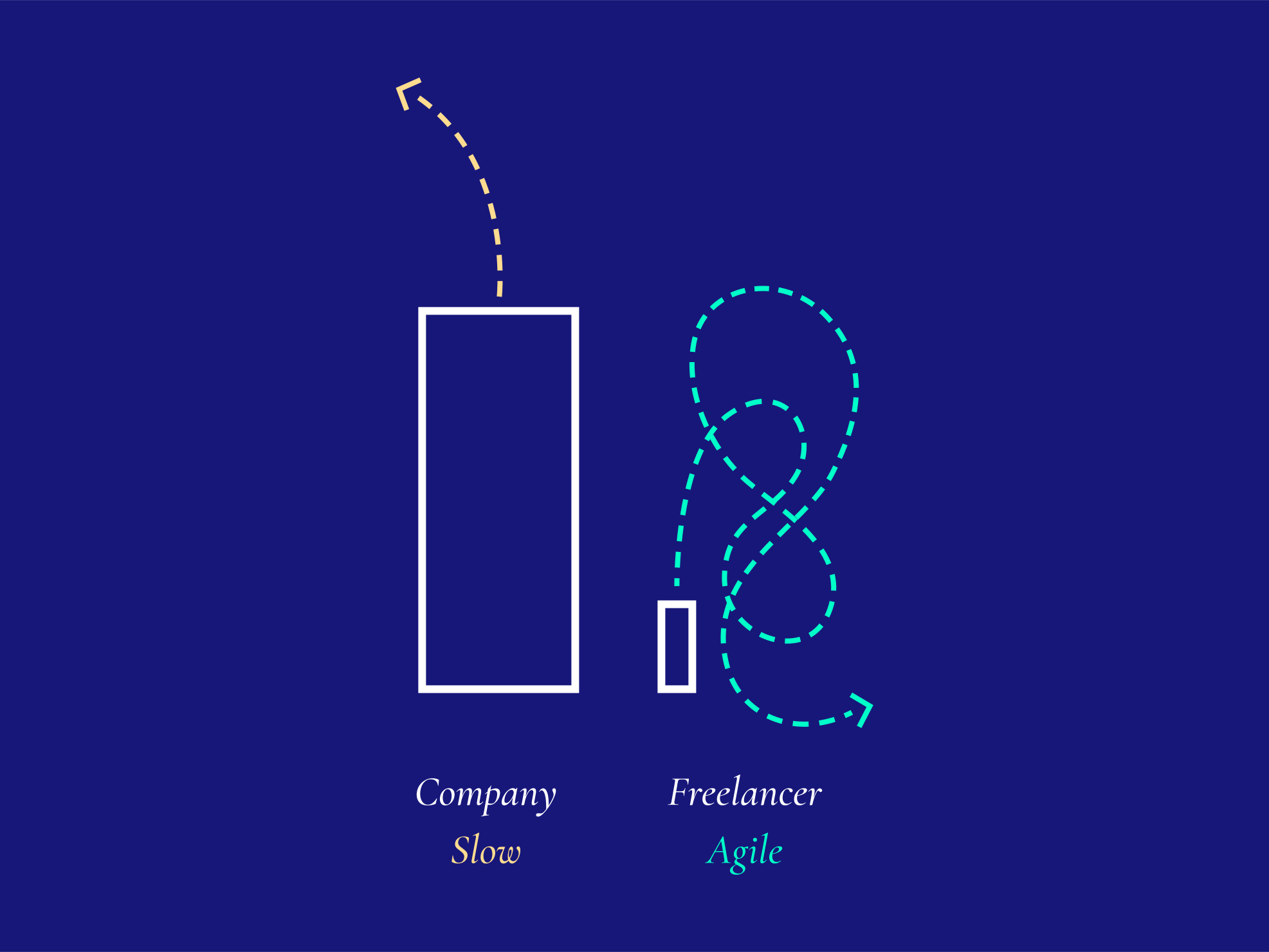
The illustration in the book puts the two side by side. On the left, a tall white rectangle labelled Company, Slow, with a single dashed yellow arrow curving up from it. On the right, a tiny rectangle labelled Freelancer, Agile, whose dashed turquoise path loops freely in many directions. Big and slow to turn on one side. Small and able to go almost anywhere on the other.
Why agencies need freelancers
The larger the company, the harder it is to move and adapt quickly. Rigid systems and layers of approval make change slow, and hiring a permanent person can take months. A freelancer can fill the gap in days.
The book points to two main reasons companies bring in freelancers: projects that sit outside their usual remit, and moments when they need extra hands. In practice that looks like too many projects landing at once, a pitch or launch that needs more people for a couple of weeks, a client asking for motion, illustration or copy the team doesn’t have, or someone going on holiday while the work still needs doing.
I worked as a digital designer at a London agency, and from the inside it’s easy to see why a reliable freelancer who can start on Monday is worth a lot.
How to find the right agencies
The book’s advice is to identify the agencies that need your services and reach out to them. The word that matters there is need. Don’t email every agency in your city. Look for a fit.
The best targets often do similar work to yours but are missing a skill. A branding studio that never shows motion work may well need a motion designer. Agencies whose work you genuinely admire are worth prioritising too, because you’ll write a better email and do better work for them. Size matters as well. Small and mid sized studios usually move faster on freelance help than large networks with formal procurement.
To find them, look through agency directories, award sites and LinkedIn, check the credits on campaigns you like, and go to local creative meetups. Aim for a list of twenty. For each, note who books freelancers, which is usually a studio manager, a producer or a creative director.
The email to send
In the book, the example email reads like this:
Hi [agency],
I’m [name]. I’ve been following your work and I love what you do. I’m a [job] with [number] years of experience in the field. I’d like to offer my services as a freelancer if you have overflow work or tight deadlines. You can see my work at [link].
Kind regards,
[Name]
It works because it’s short and makes a clear offer. You can make it stronger with a few small additions.
Name a specific project of theirs, so it’s obvious you actually looked. Link only to relevant work, one page or three projects that match their style, rather than your whole portfolio. Say what you’d take off their plate, for example turning around social assets from their brand guidelines within two days. Mention when you’re available, because “I have space from next month” makes it easy to say yes. And if you hear nothing, follow up once after a week or two with a short note and one new piece of work.
Become the freelancer they call first
Landing the first job is only half of it. Being booked again comes down to a few habits.
Follow their process and file conventions without being asked. Hit your deadlines, and warn them early if something is going to slip. Remember that the client relationship belongs to the agency, so never contact their clients directly. And be easy to work with: clear rates, quick replies, simple invoices.
Agencies talk to each other. A good freelancer gets passed around.
Mistakes to avoid
The biggest one is the generic mass email. Studio managers can spot it in seconds.
Another is attaching a huge portfolio PDF. A link to a short, relevant selection is easier to open and easier to remember.
Pricing is the next trap. Agencies add their own margin on top of your fee, so pricing exactly as you would for a direct client can price you out. Agree a day or project rate that works for both of you, and be clear about what’s included.
Finally, watch confidentiality. You may not be allowed to show agency work publicly, so ask before you post it.
Questions people ask
Do agencies hire freelancers?
All the time, for overflow, tight deadlines, holiday cover and skills the team doesn’t have. Small and mid sized studios often book freelancers quickly.
Who should I email at an agency?
Usually the studio manager, a producer or the creative director. Agency websites and LinkedIn will often tell you who books freelancers.
How much should I charge an agency?
Agree a day or project rate that leaves room for the agency’s margin and still works for you. Be clear about what’s included and how revisions work.
Try it in 15 minutes
- List five agencies whose work you like and where your skills fill a gap.
- Find the right contact at each one.
- Personalise the email for the first agency, naming one of their projects.
- Send it.
Do the next four tomorrow, and you’ll have a small pipeline by the end of the week.
All Laid Back Freelancing lessons
Cover photo by Nasik Lababan on Unsplash.